The cloud-native world and what's next
How Helm packages applications, what observability means, where the CNCF fits, and the next steps after this course, from the KCNA to the CKAD and CKA.





Diagrams in this video · 1Free in archhy
Now try it on a real cluster
The videos are free. Gazeek's hands-on labs give you a real Kubernetes cluster in your browser for every lab, with checks that tell you when you've got it right: the practice the CKA and CKAD exams need.
The diagrams, full size
Copy any of them into archhy, free, and change it for your own system.
After this lesson you can
- Explain what Helm and its charts do
- Name the three kinds of observability data, metrics, logs and traces
- Describe the CNCF and its landscape of cloud-native projects
- Choose a next step, the KCNA, the CKAD or the CKA, and how to practice for it
Transcript
The cloud-native world and what's next
Space Llama here, for the last lesson. I'm told I should be emotional. I'll pass. Kubernetes doesn't work alone. It sits in a much bigger world, called cloud native. We'll look at Helm, at observability, and at the CNCF. Then at what you can learn next.
Helm: packages for Kubernetes
A real application needs lots of YAML files. A Deployment, a Service, a ConfigMap, and more. Helm is a package manager for Kubernetes. It bundles those files into a package called a chart. Values let you customize each install. A different name, more replicas, another image tag. Then Helm installs the chart, upgrades it, and rolls it back if an upgrade goes wrong. Each install is called a release. Think app store, but with more YAML.
Observability
Observability means being able to see what's happening inside your system. It comes from three kinds of data. Metrics are numbers over time. CPU use, memory, requests per second. Logs are records of what happened, line by line. Traces follow one request as it passes through several services, so you can see where it slowed down. Kubernetes components produce all three. Tools like Prometheus and OpenTelemetry collect them.
The CNCF
Who looks after Kubernetes? The CNCF. That's the Cloud Native Computing Foundation. It's part of the Linux Foundation, and it's a neutral home for open source projects. Kubernetes lives there. So do Helm, Prometheus, OpenTelemetry and many more. The CNCF landscape is a map of the whole cloud-native world. It's large. Bring snacks.
Your next certification
If you want a certification, there are three to know. The KCNA is the Kubernetes and Cloud Native Associate. It's multiple choice, and tests concepts. This course covers the Kubernetes fundamentals it builds on. The CKAD and the CKA are hands-on. You solve tasks on a real cluster, at the command line, against the clock. The CKAD is for developers, building and running applications. The CKA is for administrators, setting up and running clusters themselves.
Your next steps
So what now? Practice. Watching is a start. Doing is where it sticks. Answer Gazeek's free Kubernetes practice questions, to check the ideas stayed in. Try the lab demos, on a real cluster built for you. Then work through a lab course, for the CKAD or the CKA, one rung at a time. Keep going until kubectl feels boring. Boring is good. Boring means you know it.
Around the cluster
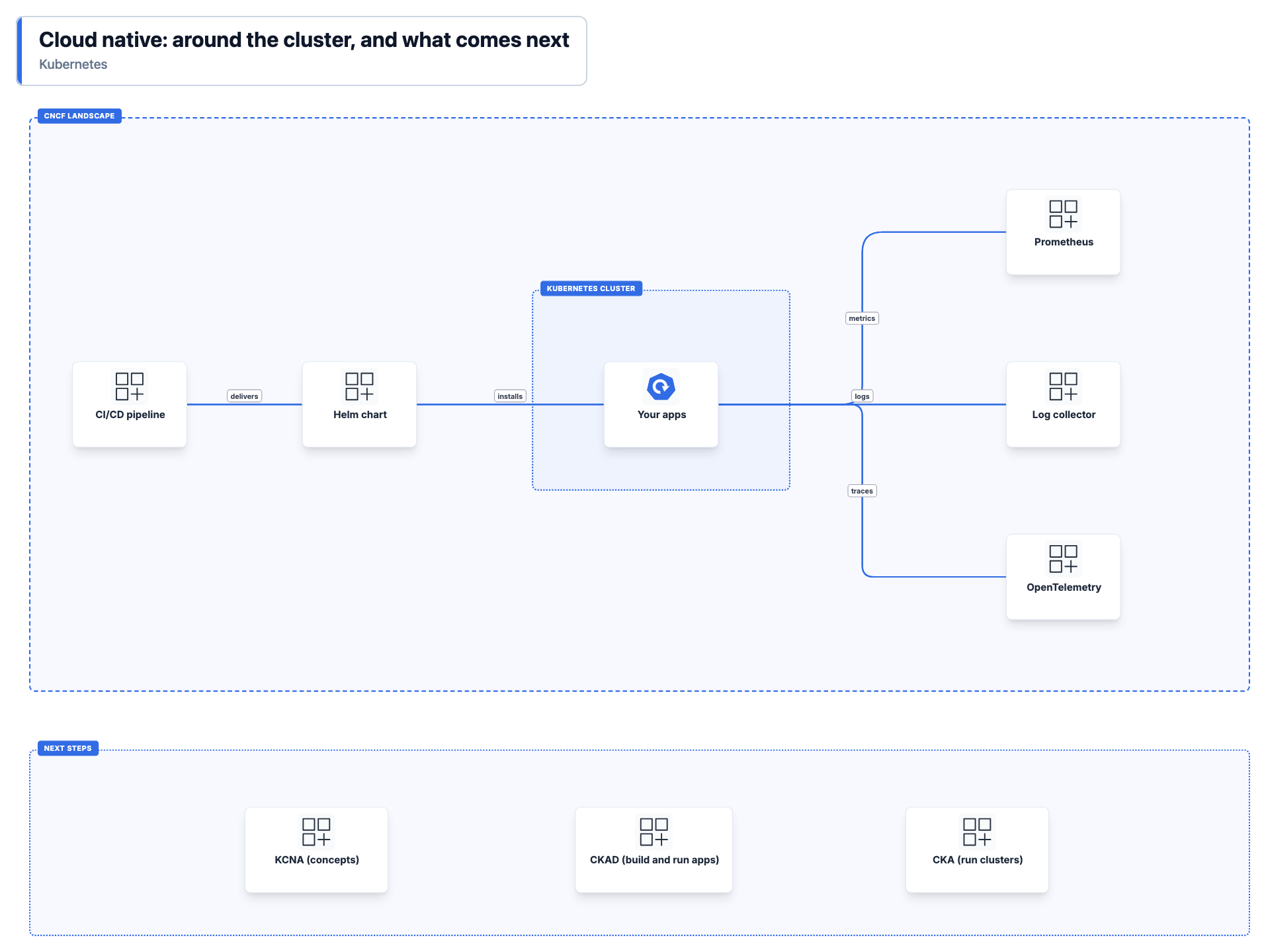
Here's the big picture. Your apps run in the cluster, in the middle. On the left, a CI/CD pipeline delivers changes, and Helm installs them as a chart. On the right, the cluster is watched. Prometheus collects metrics, a log collector gathers logs, and OpenTelemetry carries traces. Around all of it, the CNCF landscape. Most of these tools live there. And below, your next steps. The KCNA for concepts. The CKAD and the CKA for hands-on skill.
Recap
Let's recap, one last time. Helm packages applications as charts, and installs, upgrades and rolls them back. Observability comes from metrics, logs and traces. The CNCF is Kubernetes' home, alongside many other cloud-native projects. The KCNA tests concepts. The CKAD and CKA test you hands-on. And whichever you choose, practice is the next step.
Practice and what's next
That's the whole course. From one container to the cloud-native world. You did well. For a non-llama. Your next steps are at Gazeek Labs. Free Kubernetes practice questions, lab demos, and lab courses for the CKAD and CKA. There's no next lesson. The next cluster is yours. Goodbye from Space Llama, and good luck out there. More videos on the channel. Alpaca Mango. I'll be there. I'm always there. Mate.
Hands-on labs
Now try it on a real cluster
A real Kubernetes cluster in your browser for every lab, checked as you go.
See the labs
Gazeek Flash · free
Exam questions on your phone
Free questions on What's next: quick-fire batches and timed exams, on the web or Android.