Welcome: what Kubernetes is for
Space Llama introduces Kubernetes, who this free course is for, its seven parts and how each short lesson works.





Diagrams in this video · 1Free in archhy
Now try it on a real cluster
The videos are free. Gazeek's hands-on labs give you a real Kubernetes cluster in your browser for every lab, with checks that tell you when you've got it right: the practice the CKA and CKAD exams need.
The diagrams, full size
Copy any of them into archhy, free, and change it for your own system.
After this lesson you can
- Say in one sentence what Kubernetes is for
- Tell whether this course is the right starting point for you
- Name the seven parts of the course
- Explain how a lesson works, from chapters to the practice link
Transcript
Welcome: what Kubernetes is for
Hello. I'm Space Llama. Astronaut, llama, and for the next hour or so, your Kubernetes teacher. This is Kubernetes Fundamentals. It's free, and you don't need to sign in. In this first lesson, we'll look at what Kubernetes is for, who this course is for, and how it works. No cluster required yet. Just you and a llama.
What Kubernetes is for
Kubernetes is an open source platform for managing containerized workloads and services. In plain words, it runs your applications, packaged as containers, across many machines at once. You tell it what you want running. It keeps things that way, even when something breaks. The name is Greek for helmsman, or pilot. People shorten it to K8s, because there are eight letters between the K and the s. And it runs almost anywhere. In the cloud, in a data center, or on your laptop.
Who this course is for
This course is for beginners. Maybe you've heard the word in meetings, and nodded. Very convincingly. Maybe you use Kubernetes at work, but another team runs it for you. Or you're about to study for a Kubernetes certification, like the KCNA, the CKAD or the CKA. You don't need any Kubernetes experience. Knowing what a server and an application are is enough.
The seven parts, one to four
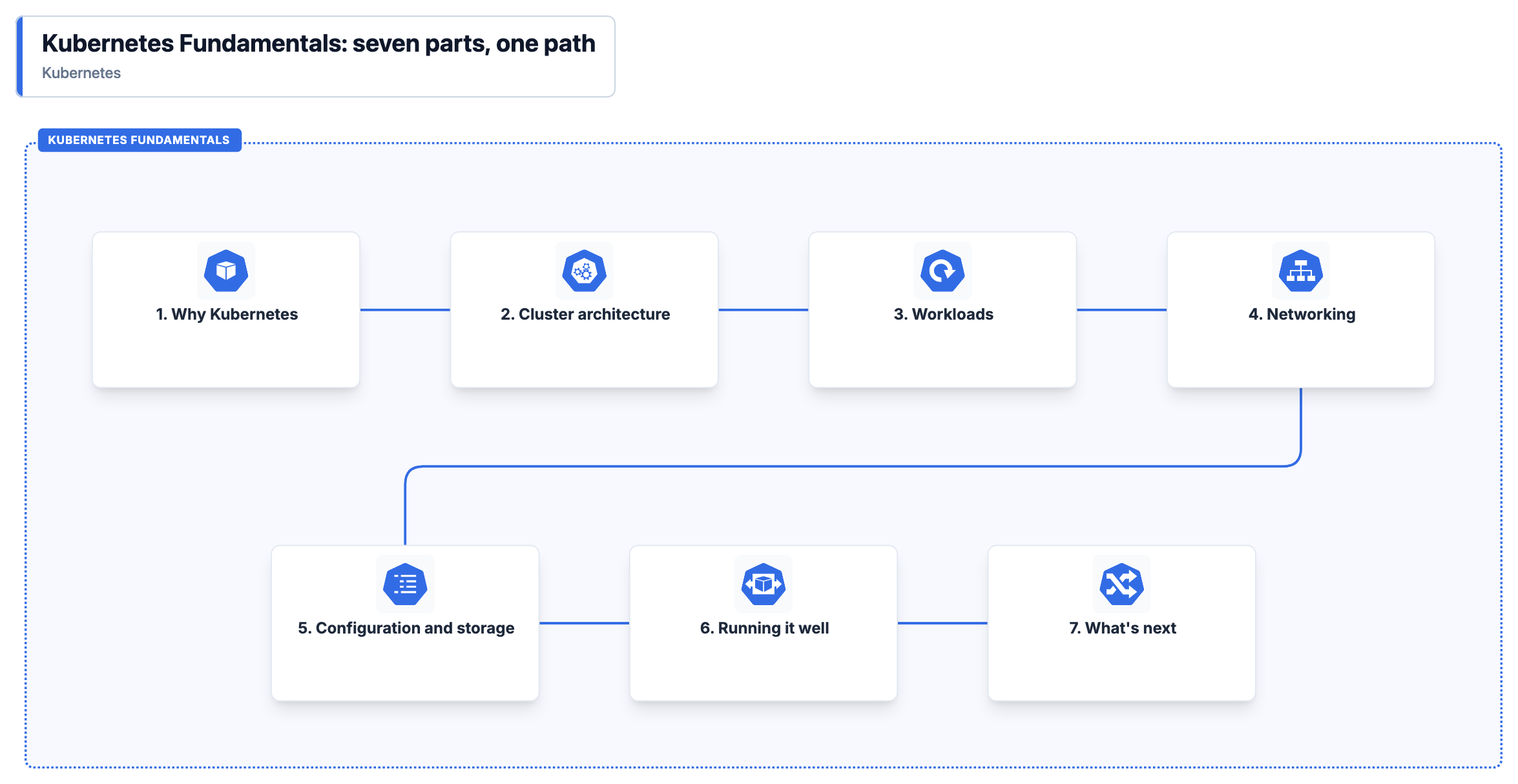
The course has seven parts. Part one is why Kubernetes. Containers, and why running lots of them needs help. Part two is cluster architecture. The control plane, the nodes, and how you talk to them. Part three is workloads. Pods, Deployments, and the other ways to run your code. Part four is networking. How your application gets found, inside and outside the cluster.
The seven parts, five to seven
Part five is configuration and storage. Settings, secrets, and data that survives a restart. Part six is running it well. Namespaces, health checks, scaling and security basics. Part seven is what's next. The wider cloud-native world, and where to go from here.
The course, as a path
Here's the whole trip on one picture. Top row first. Why Kubernetes, then cluster architecture, then workloads, then networking. The path drops down to the second row. Configuration and storage, then running it well. And it ends at what's next. The wider world, and where to go from here. Each part builds on the one before. So go in order, if you can. I'll wait.
How each lesson works
Each lesson is three or four minutes long, with one idea. Chapters let you jump between scenes, and every line has captions and a transcript. The harder ideas get architecture diagrams, drawn in archhy. You can open each one and look around. And every lesson ends with a link to practice the idea yourself.
Recap
So, a quick recap. Kubernetes runs and manages containerized applications across many machines. This course is for beginners. No experience needed. It's seven parts of short lessons, and you can practice after every one.
Practice and what's next
That's the welcome done. Painless, mostly. When you're ready to try things, Gazeek Labs has free Kubernetes practice questions and hands-on labs. Next up, Containers in five minutes. See you there.
Hands-on labs
Now try it on a real cluster
A real Kubernetes cluster in your browser for every lab, checked as you go.
See the labs
Gazeek Flash · free
Exam questions on your phone
Free questions on Getting started: quick-fire batches and timed exams, on the web or Android.