Kubernetes in the cloud and on your laptop
Where Kubernetes runs, from managed services in the cloud to self-managed clusters built with kubeadm and local clusters on a laptop, all with the same API.





Diagrams in this video · 1Free in archhy
Now try it on a real cluster
The videos are free. Gazeek's hands-on labs give you a real Kubernetes cluster in your browser for every lab, with checks that tell you when you've got it right: the practice the CKA and CKAD exams need.
The diagrams, full size
Copy any of them into archhy, free, and change it for your own system.
After this lesson you can
- Explain what a managed Kubernetes service runs for you, and what you still run
- Compare managed Kubernetes with a self-managed cluster built with kubeadm
- Name kind, minikube and k3s as ways to run Kubernetes locally
- Explain why the same Kubernetes API makes skills portable
Transcript
Kubernetes in the cloud and on your laptop
Space Llama here. Kubernetes runs almost anywhere. Today, we look at where. We'll cover managed Kubernetes in the cloud, clusters you build yourself, and clusters on your laptop. Then the good news. It's the same Kubernetes in all of them.
Two halves of a cluster
First, a quick preview of part two. A Kubernetes cluster has two halves. The control plane makes the decisions. What runs where, and what to fix. The nodes are the machines that actually run your containers. Physical or virtual. Where you run Kubernetes mostly changes one thing. Who looks after each half.
Managed Kubernetes
With managed Kubernetes, a cloud provider runs the control plane for you. It keeps it available, backed up and upgraded. You run your workloads on it. Examples are Google Kubernetes Engine, Amazon Elastic Kubernetes Service, and Azure Kubernetes Service. You'll hear them called G K E, E K S and A K S. Each provider also offers ways to manage the nodes, so there's even less for you to do. The trade-off is control. You can't tinker with a control plane you can't see.
Managed vs self-managed
The other option is to run the whole thing yourself. A common tool for that is kubeadm. It sets up a cluster on machines you provide. That gives you full control, on your own hardware or on cloud servers. It also gives you all the chores. Upgrades, backups and fixing the control plane are yours. Managed is quicker to start. Self-managed teaches you more. Both are real Kubernetes.
Kubernetes on your laptop
You can also run Kubernetes on your own computer. kind, short for Kubernetes in Docker, runs each node as a container. minikube runs a local cluster, made for learning and trying things out. k3s is a lightweight Kubernetes distribution. Small enough for a laptop, or a tiny computer. Local clusters are free, private and easy to throw away. Perfect for experiments.
The same API everywhere
Here's the good news. Every one of these speaks the same Kubernetes API. The API is how you, and your tools, talk to the cluster. So the same kubectl commands and the same YAML files work in all of them. What you learn on your laptop still works in the cloud. The edges differ a little. Load balancers and storage come from wherever the cluster runs. We'll meet those later.
Who runs what
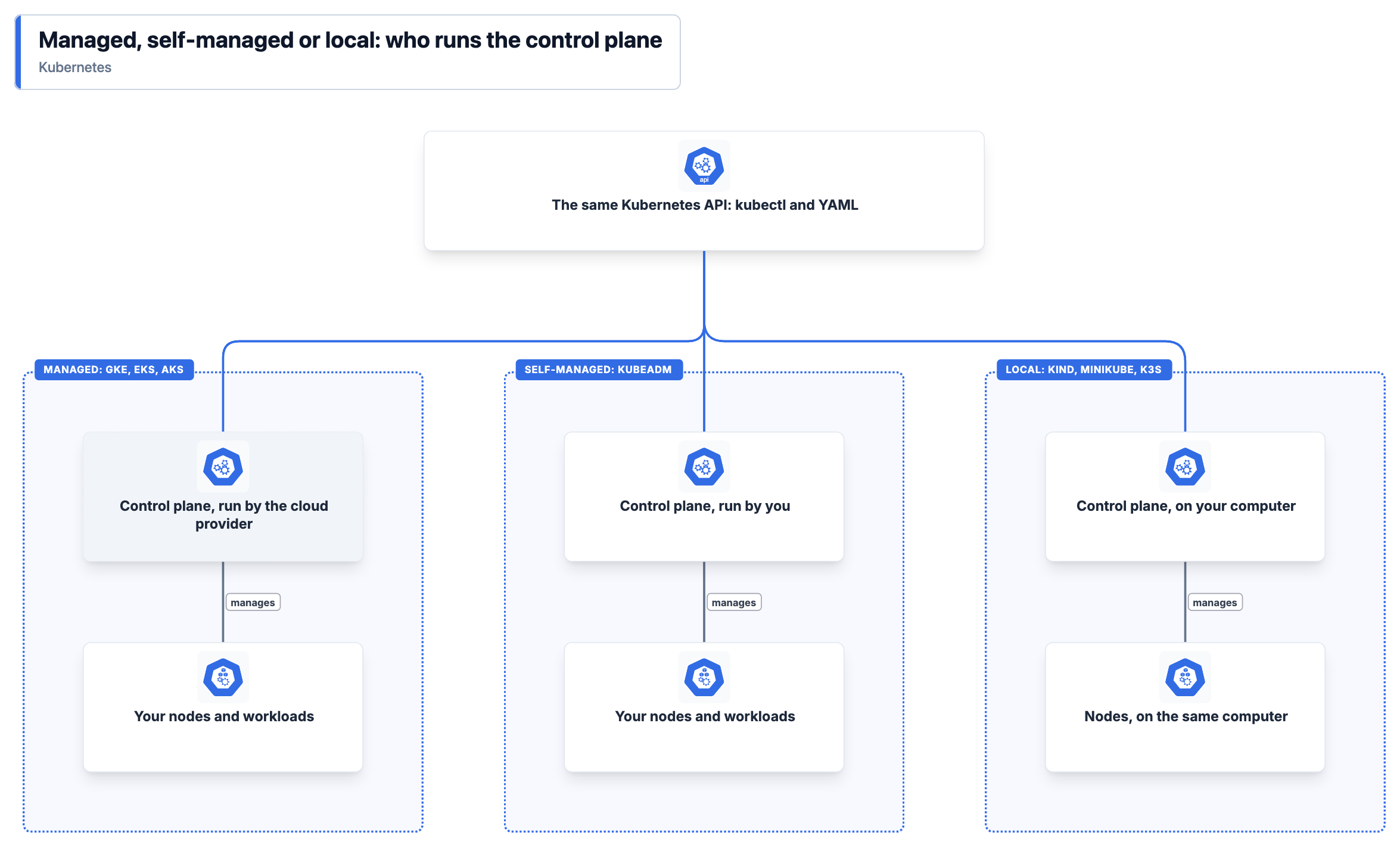
Three ways to run a cluster, side by side. On the left, managed. The cloud provider runs the control plane. You run your nodes and workloads. In the middle, self-managed. You run the control plane and the nodes, often set up with kubeadm. On the right, local. kind, minikube or k3s put the whole cluster on your own computer. And across the top, one Kubernetes API. Same kubectl, same YAML, whichever column you pick.
Recap
Let's recap. The control plane decides, and the nodes run your containers. With managed Kubernetes, like GKE, EKS or AKS, the provider runs the control plane. Self-managed, often with kubeadm, means you run everything. kind, minikube and k3s run Kubernetes locally. And it's one API everywhere, so your skills travel with you.
Practice and what's next
That's where Kubernetes lives. Basically everywhere. Like sand in a spacesuit. Try free Kubernetes practice questions and hands-on labs at Gazeek Labs, on a real cluster built for you. Next up, part two. The cluster, its control plane and its nodes. See you there. If you learned something, there's more on the channel. If you didn't, also the channel. Mate.
Hands-on labs
Now try it on a real cluster
A real Kubernetes cluster in your browser for every lab, checked as you go.
See the labs
Gazeek Flash · free
Exam questions on your phone
Free questions on Why Kubernetes: quick-fire batches and timed exams, on the web or Android.