The shared responsibility model
Space Llama explains the AWS shared responsibility model, who secures what between AWS and the customer, and how the line moves from Amazon EC2 to managed and serverless services.





Diagrams in this video · 1Free in archhy
The diagrams, full size
Copy any of them into archhy, free, and change it for your own system.
After this lesson you can
- Explain security of the cloud and security in the cloud
- List the responsibilities that always stay with the customer
- Describe how responsibilities shift between Amazon EC2, Amazon RDS, AWS Lambda and Amazon S3
- Name the shared controls of patching, configuration, and awareness and training
Transcript
The shared responsibility model
Right. Security and Compliance. The second domain, and 30 percent of the exam. We start with the idea that everything else in this domain hangs on. The shared responsibility model. In short, who looks after what, you or AWS. We'll cover security of the cloud, security in the cloud, and how the line moves between services. Then a diagram, and the few controls you share.
Security of the cloud
Start with the AWS half. That's security of the cloud. AWS protects the infrastructure that runs every service it offers. That means the data centers, the hardware inside them, and the global network between them. It also means the software that provides compute, storage, database and networking services. You can't visit an AWS data center. You don't need to. You inherit those physical and environmental controls, and AWS gets audited on them.
Security in the cloud
Now your half. That's security in the cloud. AWS gives you the building blocks. You protect whatever you build and store with them. Your data is always yours to protect, and so is deciding who can access it. On a virtual server, the operating system, your applications and the firewall settings are yours too. So is encryption, both of stored data and of network traffic. AWS provides the tools for encryption. Turning them on and using them well is up to you.
The line moves with the service
Here's the part the exam likes. The split isn't fixed. It moves with the type of service. Amazon EC2 is infrastructure as a service. AWS runs the host, but you manage the guest operating system. You patch it, harden it, and configure its security groups. Amazon RDS is a managed service. AWS patches the database engine and the operating system under it. You still manage database users, network access and whether encryption is on. AWS Lambda is serverless. AWS runs the servers, the operating system and the runtime. You look after your code and the permissions the function has. Amazon S3 is serverless storage. You control who can access each bucket and its objects. The more managed the service, the less you do. But your data and access stay yours, every time.
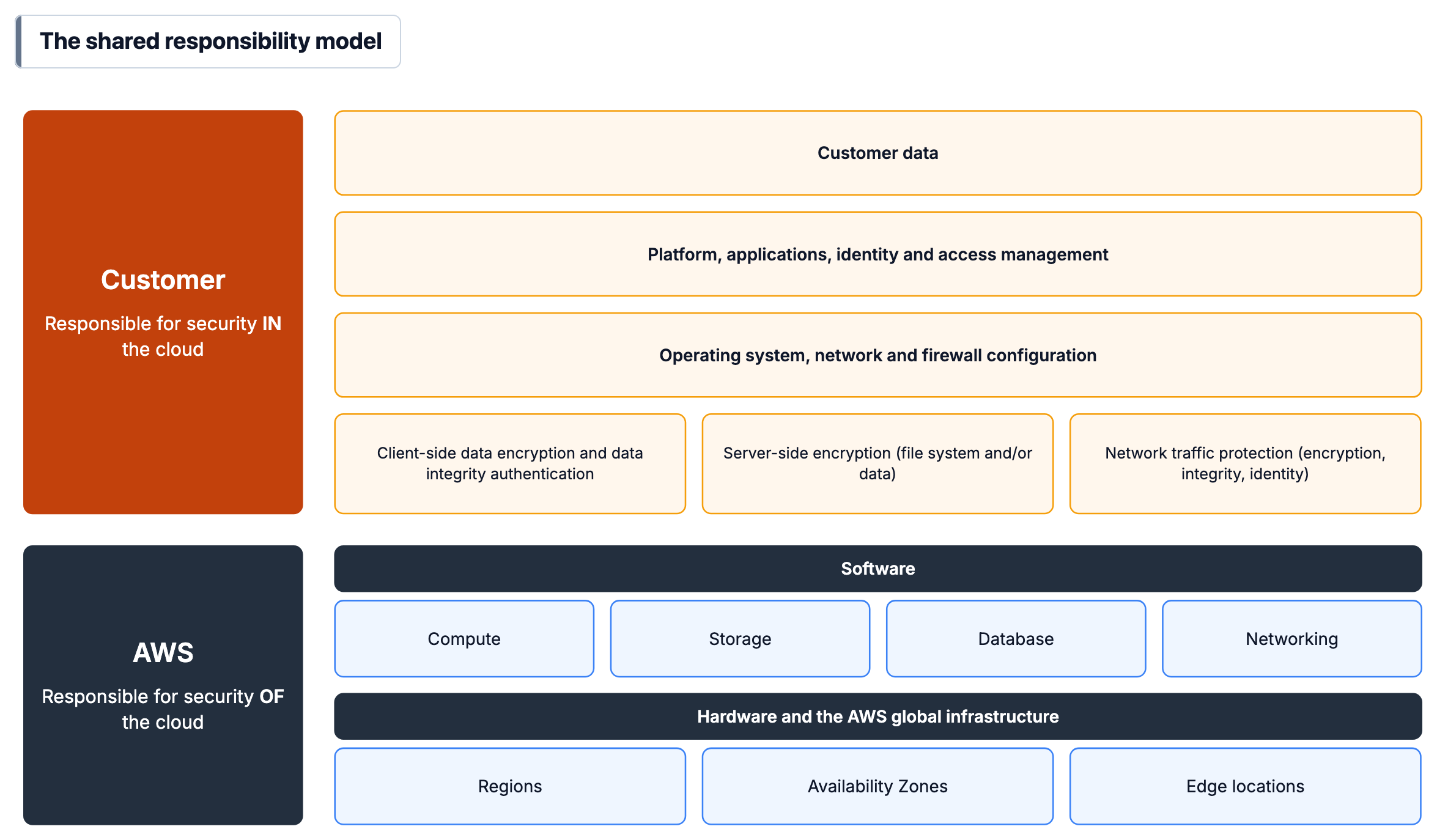
Diagram
Here's the model as one picture. Read it from the top down. The top layer is the customer. That's security in the cloud. At the very top is customer data. Under that, the platform, your applications, and identity and access management. Then the operating system, plus network and firewall configuration. Then encryption, and protection of network traffic. The bottom layer is AWS. That's security of the cloud. First the software, meaning compute, storage, database and networking. And underneath everything, the hardware and the AWS global infrastructure. That's Regions, Availability Zones and edge locations.
Controls you share
A few controls belong to both of you, at different layers. Patch management. AWS patches its infrastructure, and you patch your guest operating systems and applications. Configuration management. AWS configures its devices, and you configure your own operating systems, databases and applications. Awareness and training. AWS trains its staff, and you train yours. Same control, two owners. Each one handles its own side.
Recap
Quick recap. AWS handles security of the cloud. The buildings, the hardware and the service software. You handle security in the cloud. What you build and store. The more managed the service, the less there is for you to do. But your data and who can access it stay yours, on every service. And patching, configuration, and awareness and training are shared, each side at its own layer.
Practice and what's next
That's the shared responsibility model. Simple enough, once you know which side of the line you're on. Try some Security and Compliance questions in Gazeek Flash to check you've got it. The AWS app is free on the web and on Android, at flash.gazeek.com. Next up, IAM: users, groups, roles and policies. See you there.

Gazeek Flash · free
Exam questions on your phone
Free questions on Security and Compliance: quick-fire batches and timed exams, on the web or Android.