The AWS Well-Architected Framework, explained
The six pillars after AWS's 16 Nov 2026 update, as the questions a consultant asks, with the AWS tools that help and the free Well-Architected Tool.





Diagrams in this video · 7Free in archhy
The diagrams, full size
Copy any of them into archhy, free, and change it for your own system.
- Drawing the picture…
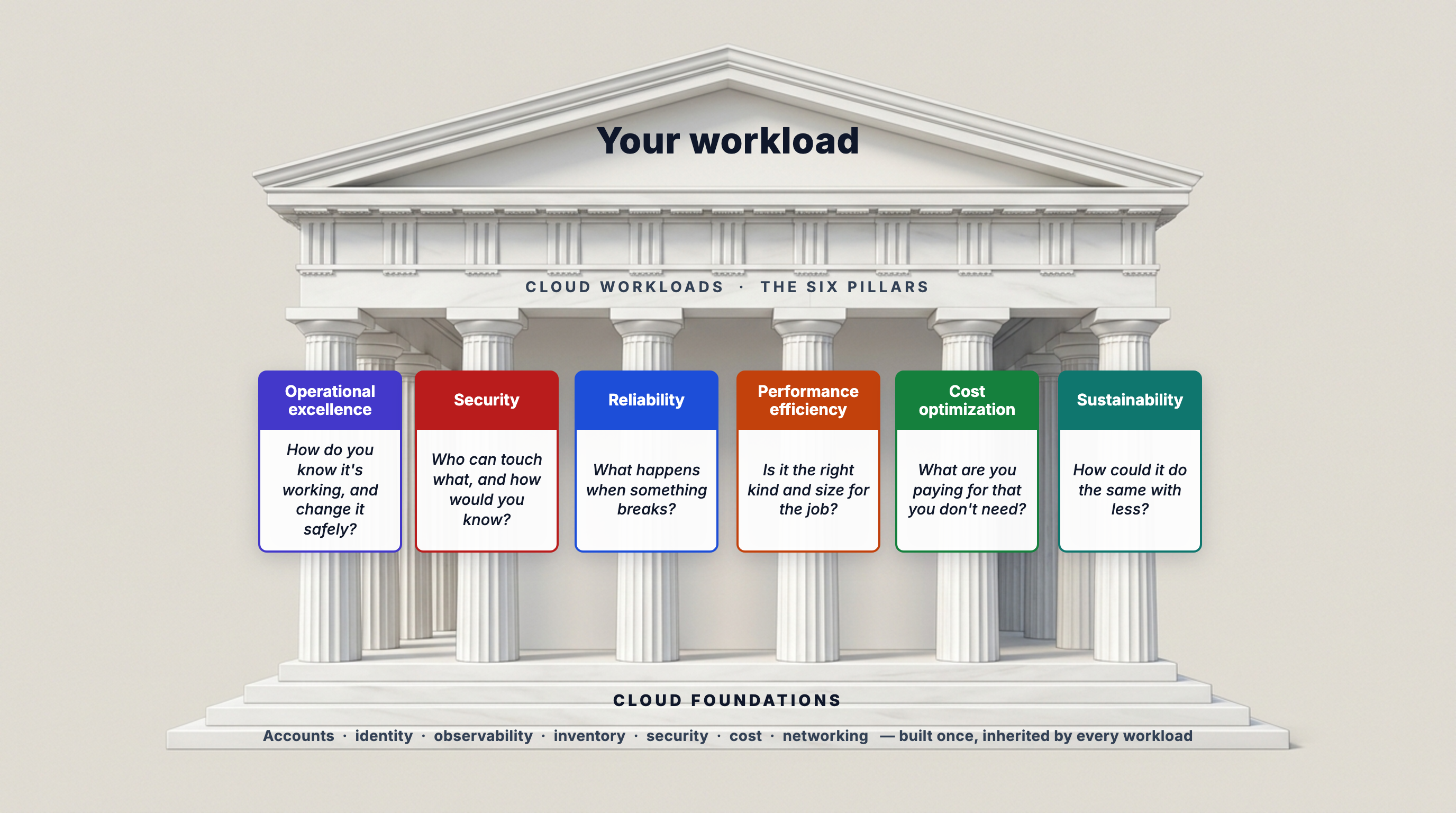 D1Six pillars, six questionsAt 0:21 · Copy and edit in archhy (opens in a new tab)
- Drawing the picture…
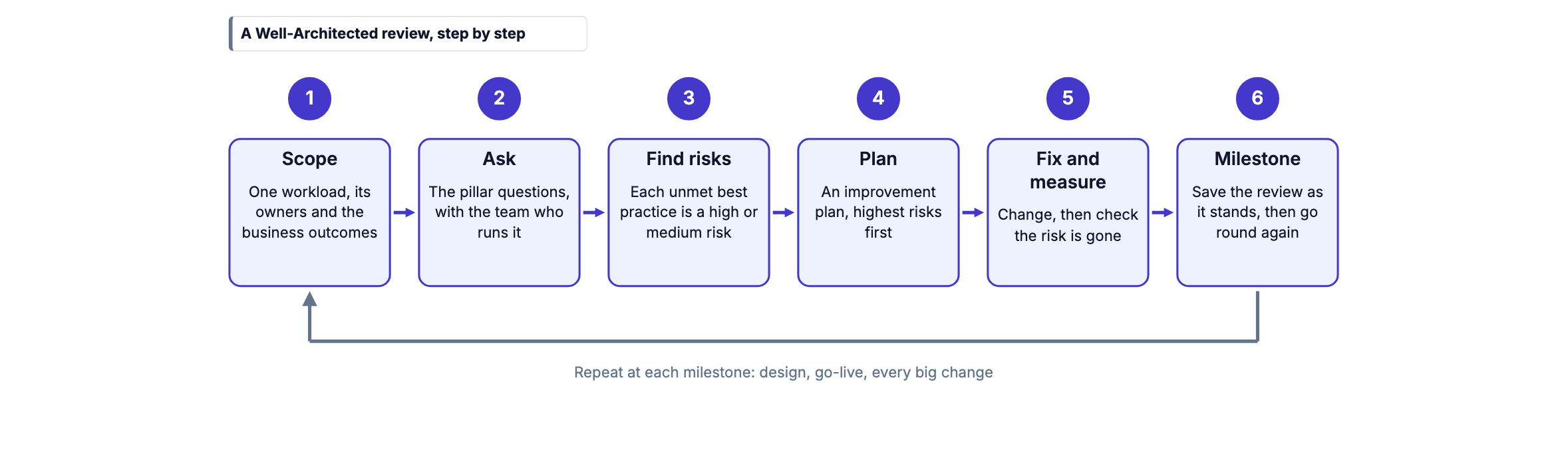 D2How a review worksAt 2:12 · Copy and edit in archhy (opens in a new tab)
- Drawing the picture…
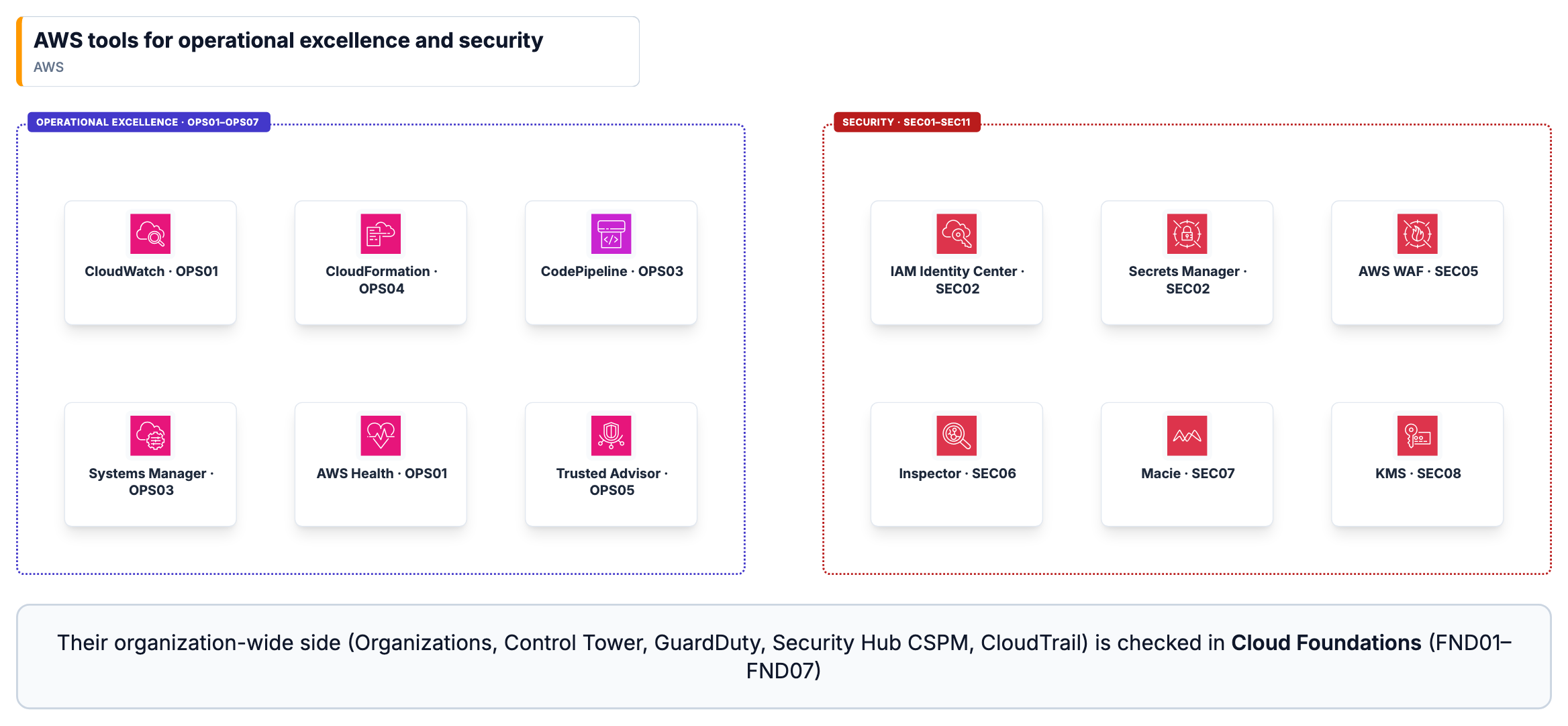 D3Operational excellence and securityAt 3:02 · Copy and edit in archhy (opens in a new tab)
- Drawing the picture…
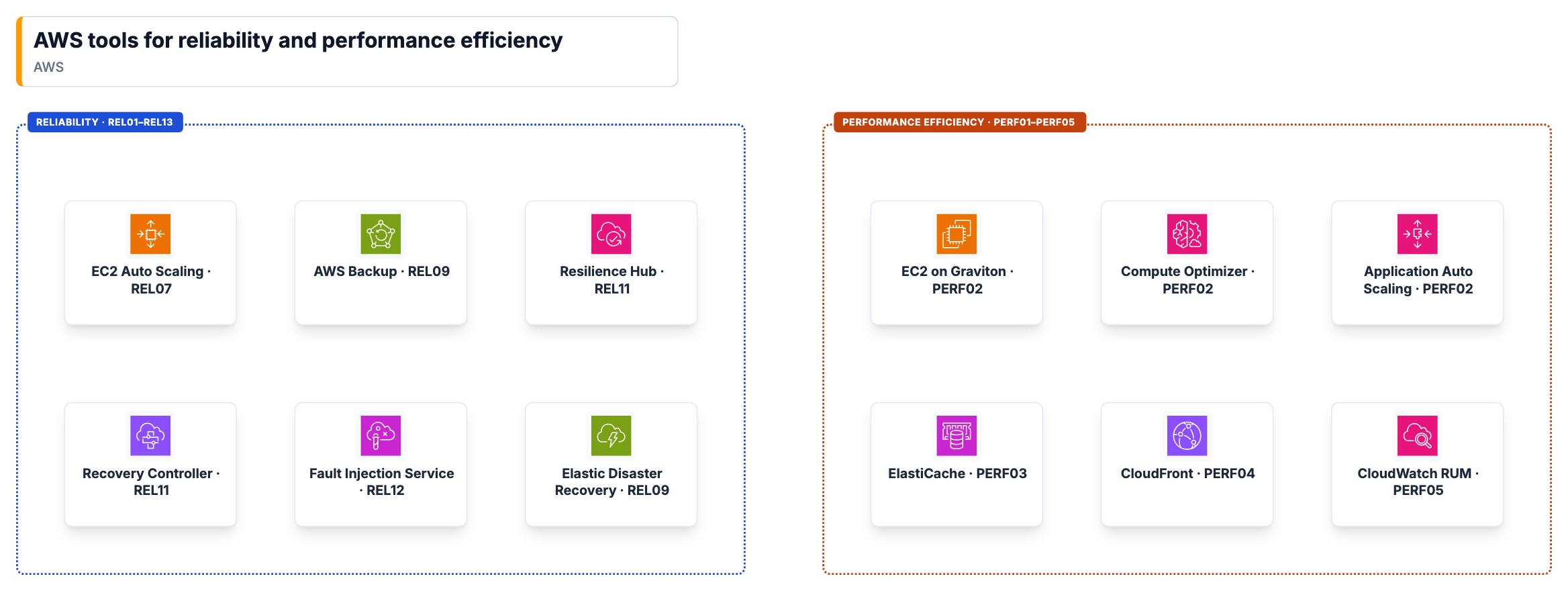 D4Reliability and performance efficiencyAt 3:55 · Copy and edit in archhy (opens in a new tab)
- Drawing the picture…
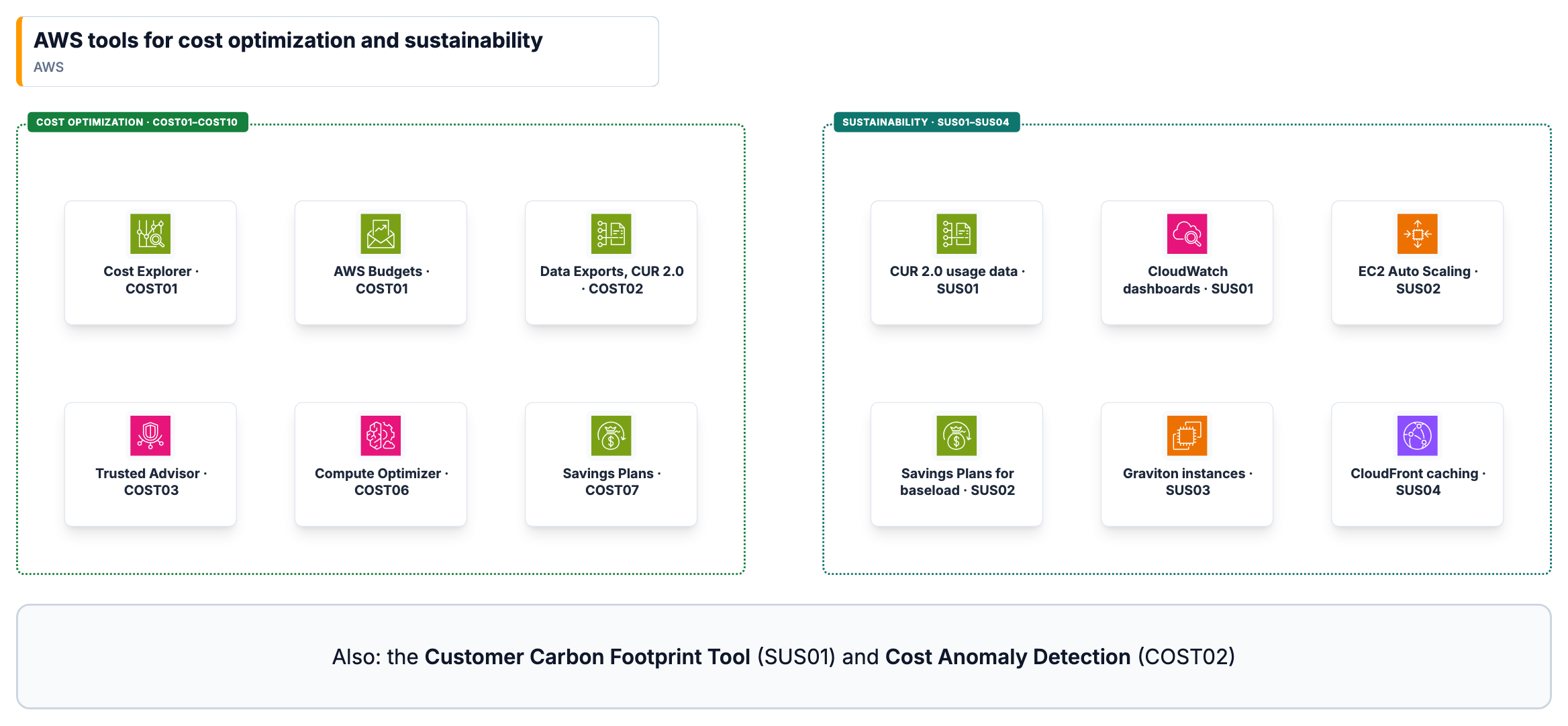 D5Cost optimization and sustainabilityAt 4:29 · Copy and edit in archhy (opens in a new tab)
- Drawing the picture…
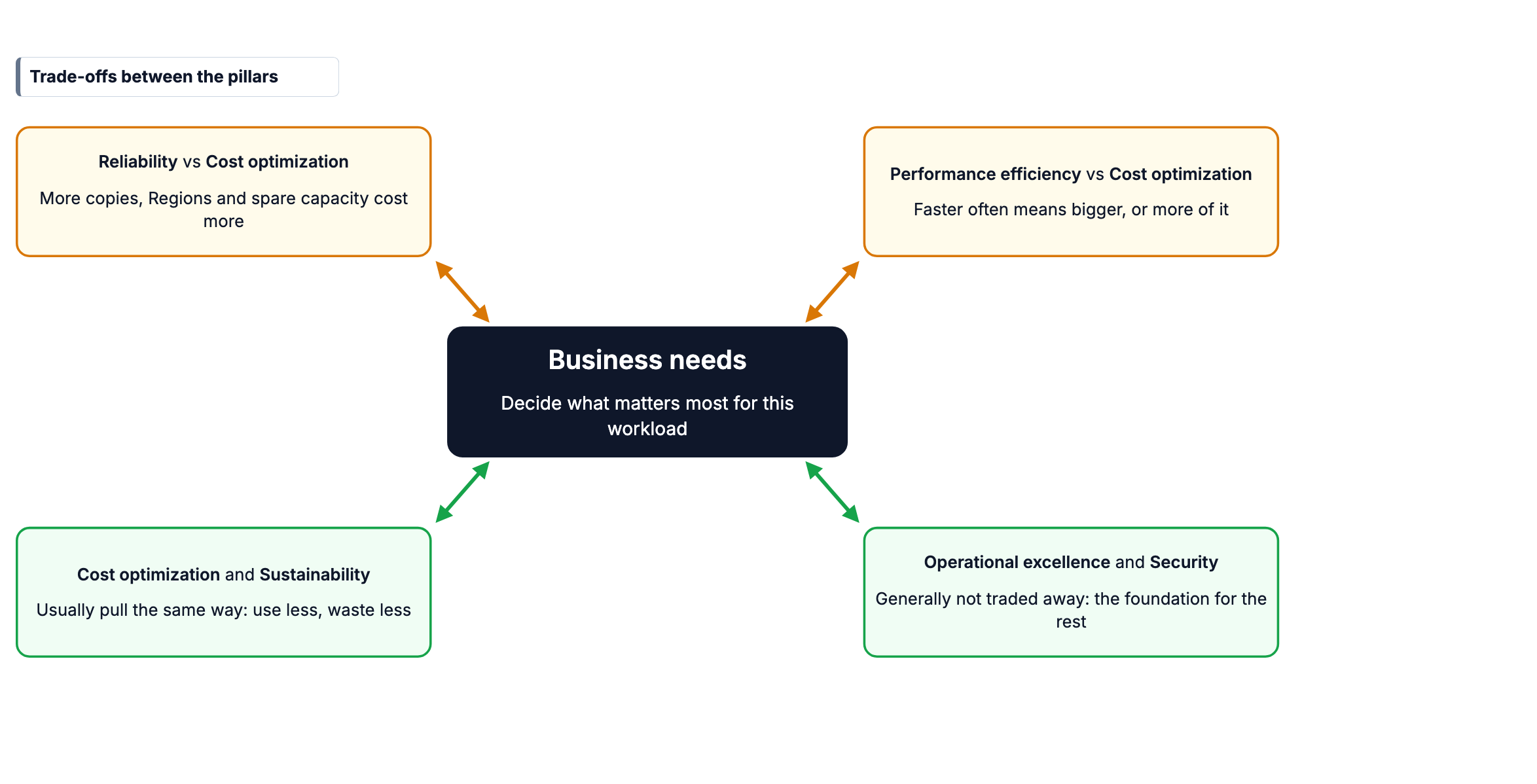 D6Trade-offsAt 4:54 · Copy and edit in archhy (opens in a new tab)
- Drawing the picture…
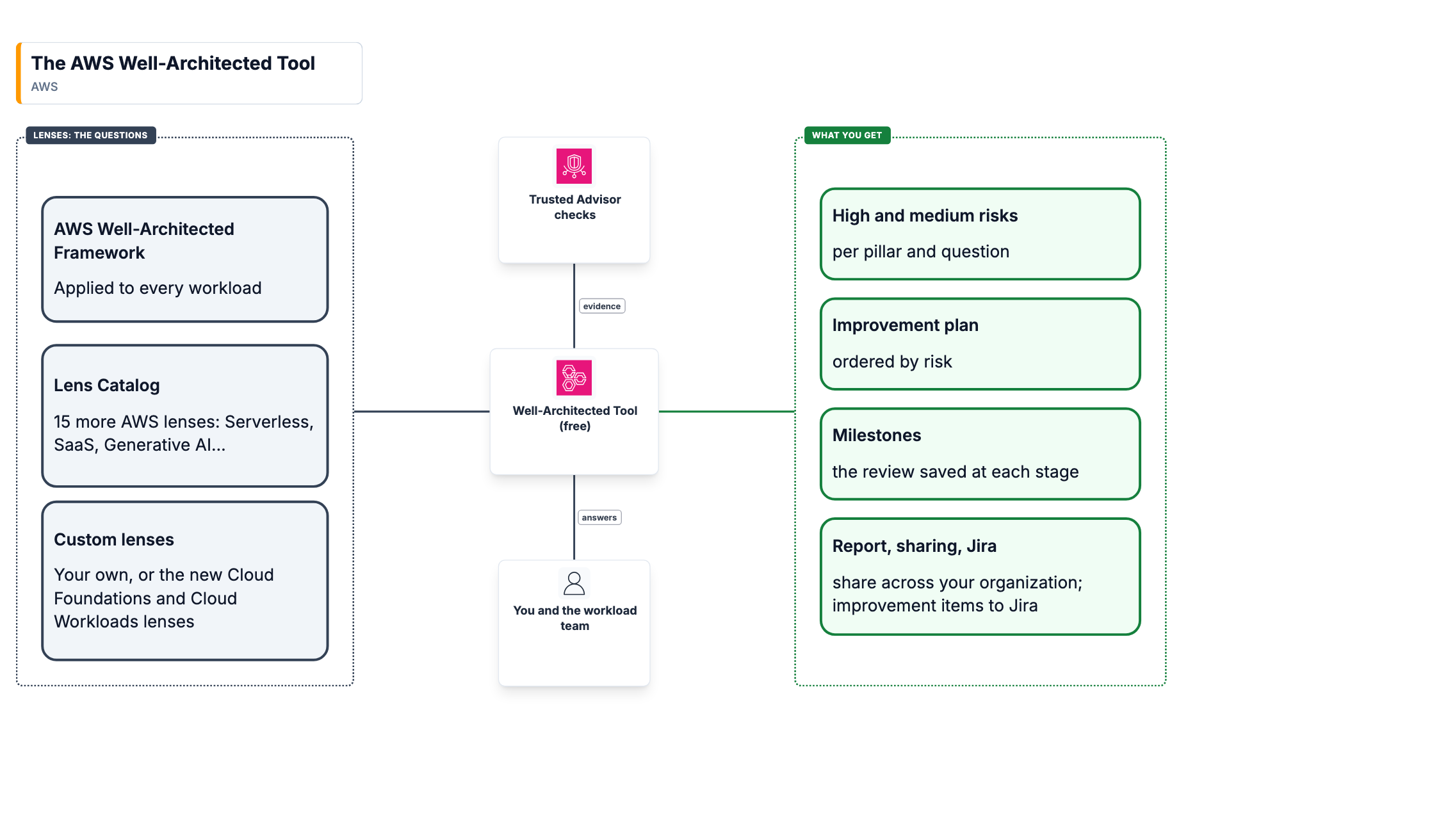 D7The AWS Well-Architected ToolAt 5:18 · Copy and edit in archhy (opens in a new tab)
After this lesson you can
- Name the six pillars and the question each one asks of a workload
- Explain what changed on 16 Nov 2026, Cloud Foundations and Cloud Workloads
- Run a Well-Architected review, from scope to milestone
- Pick the AWS tools the framework names for each pillar
Transcript
The AWS Well-Architected Framework, explained
Space Llama here, with Architecture Ideas. Today, the AWS Well-Architected Framework. Six pillars, and the questions a good consultant asks about each one. And it's news: AWS rebuilt the framework on the sixteenth of November, 2026. So even if you know it, stick around.
Six pillars, six questions
Picture the framework as a temple. On top sits your workload. One at a time: the app, its data, and the people who run it. Operational excellence. How do you know it's working, and how do you change it safely? Security. Who can touch what, and how would you know? Reliability. What happens when something breaks? Performance efficiency. Is it the right kind and size for the job? Cost optimization. What are you paying for that you don't need? Sustainability. How could it do the same with less? And the steps underneath are new. Cloud Foundations: accounts, identity, observability, inventory, security, cost and networking, built once for the whole organization, and inherited by every workload. Those six are how a consultant opens each pillar. AWS's official questions go deeper.
What changed on 16 Nov 2026
So what changed? The six pillar whitepapers became one framework. Account-wide decisions moved into Cloud Foundations: seven questions you answer once, for the whole organization. The six pillars now sit under a new heading, Cloud Workloads. Together they ask fifty questions, down from fifty-seven. In the pillars, best practices went from three hundred and seven to two hundred and sixteen, and Cloud Foundations has forty-five of its own. AWS says no technical coverage was lost: much of it moved, or merged. Best practices about business strategy and people were retired, because they rest on human judgment, and that makes reviews easier to automate. To review against the new version, import AWS's two new custom lenses into the Well-Architected Tool.
How a review works
How does a review actually run? AWS calls it a constructive conversation, not an audit. Its guide has three phases: prepare, review, improve. Here is how a consultant runs it, in six steps. Scope: one workload, its owner, and what the business needs from it. Ask: work through the questions with the engineers who run it, not just the architect who drew it. Find risks. Each best practice you miss is a high risk or a medium risk. There's no low. Plan: turn the risks into an improvement plan, highest risk first. Fix, and measure again. Milestone: save the review as it stands. Then go round again at the next big change. Design, go-live, and every big change after that.
Operational excellence and security
Now the tools. These are the services the framework's own best practices name, each tagged with its question. Operational excellence has seven questions. CloudWatch for telemetry, CloudFormation and CodePipeline for safe change, Systems Manager for patching. A consultant asks: walk me through your last deployment. How would you roll it back? Security has eleven. IAM Identity Center is the single sign-on for your people. IAM stands for Identity and Access Management. Then Secrets Manager, a web application firewall, Inspector, Macie, and the Key Management Service. A consultant asks: if someone used a stolen key at three in the morning, what would tell you? The organization-wide pieces, like GuardDuty and CloudTrail, are also checked in Cloud Foundations.
Reliability and performance efficiency
Reliability asks thirteen questions. Auto Scaling, AWS Backup, Resilience Hub, the Application Recovery Controller, and Fault Injection Service for breaking things on purpose. The consultant's favorite: when did you last restore from a backup, and how long did it take? Performance efficiency asks five. Graviton processors, Compute Optimizer, caching with ElastiCache, and CloudFront to get closer to users. And: what does fast enough mean here, in numbers?
Cost optimization and sustainability
Cost optimization has ten questions. Cost Explorer, Budgets, Compute Optimizer and Savings Plans. Ask: what does one customer, or one order, cost you? Sustainability has four. Measure usage, scale with demand, run on efficient hardware like Graviton, and keep less data. Ask: how much of the data you store is ever read again?
Trade-offs
You can't max out every pillar, and the framework doesn't ask you to. Start with what the business needs. More reliability, or more speed, usually costs more. That's a decision someone should own. Cost and sustainability usually pull the same way: use less, waste less. And security and operational excellence are generally not traded away.
The AWS Well-Architected Tool
Where do you run all this? The AWS Well-Architected Tool, in the console, at no extra charge. Lenses supply the questions: the framework, fifteen more from the catalog, or your own. The team answers, workload by workload. Trusted Advisor checks can add evidence, on the paid Business and Enterprise support plans. Out come the risks, an improvement plan, milestones, a report you can share, and improvement items you can sync to Jira. There's also a new AI service in preview, the Well-Architected Agent, for customers on the higher support plans. It checks your resources every week, but it doesn't replace the conversation.
Recap
Recap. Six pillars, reviewed one workload at a time, with Cloud Foundations underneath since November. Open each pillar with a plain question, then ask to see the evidence. Trade-offs are fine, as long as someone owns them. And the Well-Architected Tool is free.
Practice and what's next
The full article has every question, every tool, and the links. It's in the description, and the diagrams open in archhy. Studying for the exam? Our AWS Cloud Practitioner course is free on Gazeek. If you learned something, there's more on the channel. If you didn't, also the channel. Mate.
Draw it in archhy
Open this episode's diagram in archhy, ready to change for your own system. Free, in the browser.