A governed data lake on AWS
How Amazon S3, AWS Glue and AWS Lake Formation make a data lake where every query engine checks one set of permissions.





Diagrams in this video · 1Free in archhy
The diagrams, full size
Copy any of them into archhy, free, and change it for your own system.
After this lesson you can
- Describe the four layers of a governed data lake
- Explain what AWS Glue, the Data Catalog and Lake Formation each do
- Weigh the design choices behind zones, file formats and permissions
- Open the diagram in archhy and adapt it to your own data
Transcript
A governed data lake on AWS
Space Llama here, with Architecture Ideas: one cloud design at a time. Today, a governed data lake on AWS. We'll walk the diagram, then hand it to you.
Data everywhere, access nowhere
Orders sit in one database, web events in another, finance in spreadsheets. Analysts copy what they can reach, and nobody knows who has the customer table. Bucket policies decide who reads files, not which columns or rows. A data lake gives you one place to find data, and one place to decide who uses it.
A governed data lake
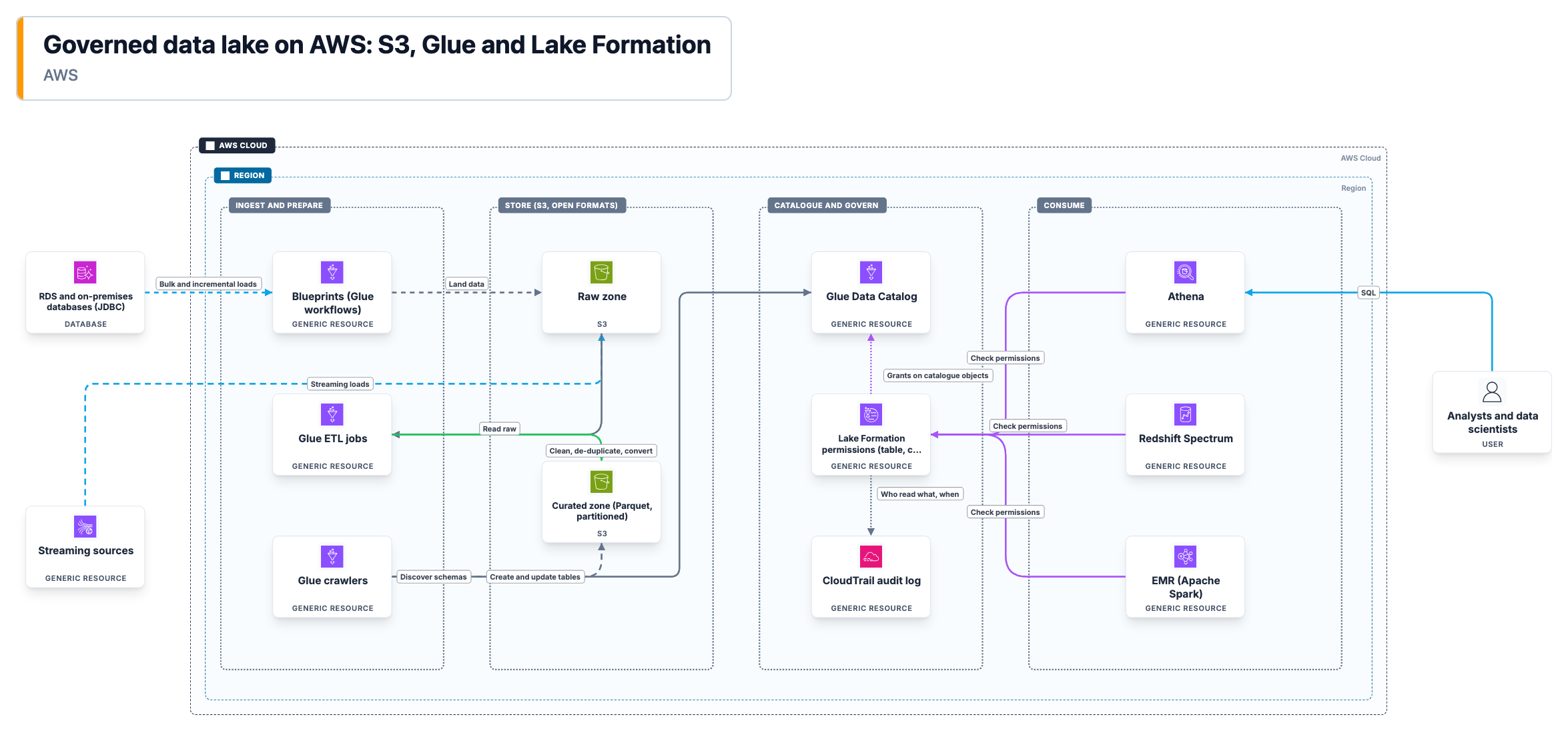
Read it left to right: ingest, store, catalog and govern, consume. Databases, on Amazon RDS or on premises, load through AWS Lake Formation blueprints, once or incrementally. Blueprints run as AWS Glue crawlers and jobs. Glue is AWS's data integration service. Streams arrive too, through a service such as Amazon Kinesis. Everything lands in Amazon S3, the object store, in your own account, in open formats. Glue ETL jobs clean the raw zone and write partitioned Parquet into the curated zone. Glue crawlers record each dataset's schema as a table in the Glue Data Catalog. Lake Formation grants access on those tables. AWS CloudTrail, the audit log, records who read what, and when. On the right, Amazon Athena, Amazon Redshift Spectrum and Amazon EMR all check Lake Formation before reading.
Lake Formation holds the permissions
Lake Formation is the heart of it: one place for access control. Grant on databases, tables and columns. Data filters reach rows and single cells. LF-Tags let you grant by label, like pii equals no, not table by table. Athena, Redshift Spectrum, EMR and Glue ETL honor the same grants. Decided once, enforced everywhere.
Choices to weigh
The raw and curated split is a convention, not a feature. Raw lets you reprocess. Athena charges by data scanned, so partitioned Parquet makes the same question cheaper. Crawlers guess schemas, so review what they create. Lake Formation sits beside IAM. Hybrid access mode lets you move one dataset at a time. One team, a few tables? IAM and bucket policies may be enough. Not every puddle needs a lake.
Draw it in archhy
Your turn. The link in the description opens this exact diagram in archhy. It's free, in your browser. Swap in your own sources, rename the zones, add a boundary per team. Then export a PNG, or share a link. The full write-up, with when not to build a lake, is on archhy's blog.
Recap
Recap. A governed data lake has four layers: ingest, store, catalog and govern, consume. Keep open formats, in your own S3 buckets. Grant on tables and columns, not buckets. Every engine checks the same permissions, and CloudTrail records each access.
Practice and what's next
Open this diagram in archhy from the link in the description, and make it yours. Read the full article on archhy's blog. Next episode, event-driven architecture on AWS. See you there.
Draw it in archhy
Open this episode's diagram in archhy, ready to change for your own system. Free, in the browser.