Kubernetes native sidecars, in depth
Native sidecars, an init container with restartPolicy: Always, stable since Kubernetes 1.33: the three problems they fix, start-up and the startup probe, shutdown order, Jobs that finish, what kubectl shows, and Istio's native sidecars.





Diagrams in this video · 2Free in archhy
Now try it on a real cluster
The videos are free. Gazeek's hands-on labs give you a real Kubernetes cluster in your browser for every lab, with checks that tell you when you've got it right: the practice the CKA and CKAD exams need.
The diagrams, full size
Copy any of them into archhy, free, and change it for your own system.
After this lesson you can
- Name the three problems native sidecars fix
- Declare a native sidecar, and gate the app on it with a startup probe
- Describe the shutdown order and why sidecar exit codes are ignored
- Explain why a Job with a native sidecar completes
Transcript
Kubernetes native sidecars, in depth
Space Llama here. Back in episode three, we met native sidecars. Today, the deep dive. What they fix, how they start and stop, and the one probe that matters.
What native sidecars fix
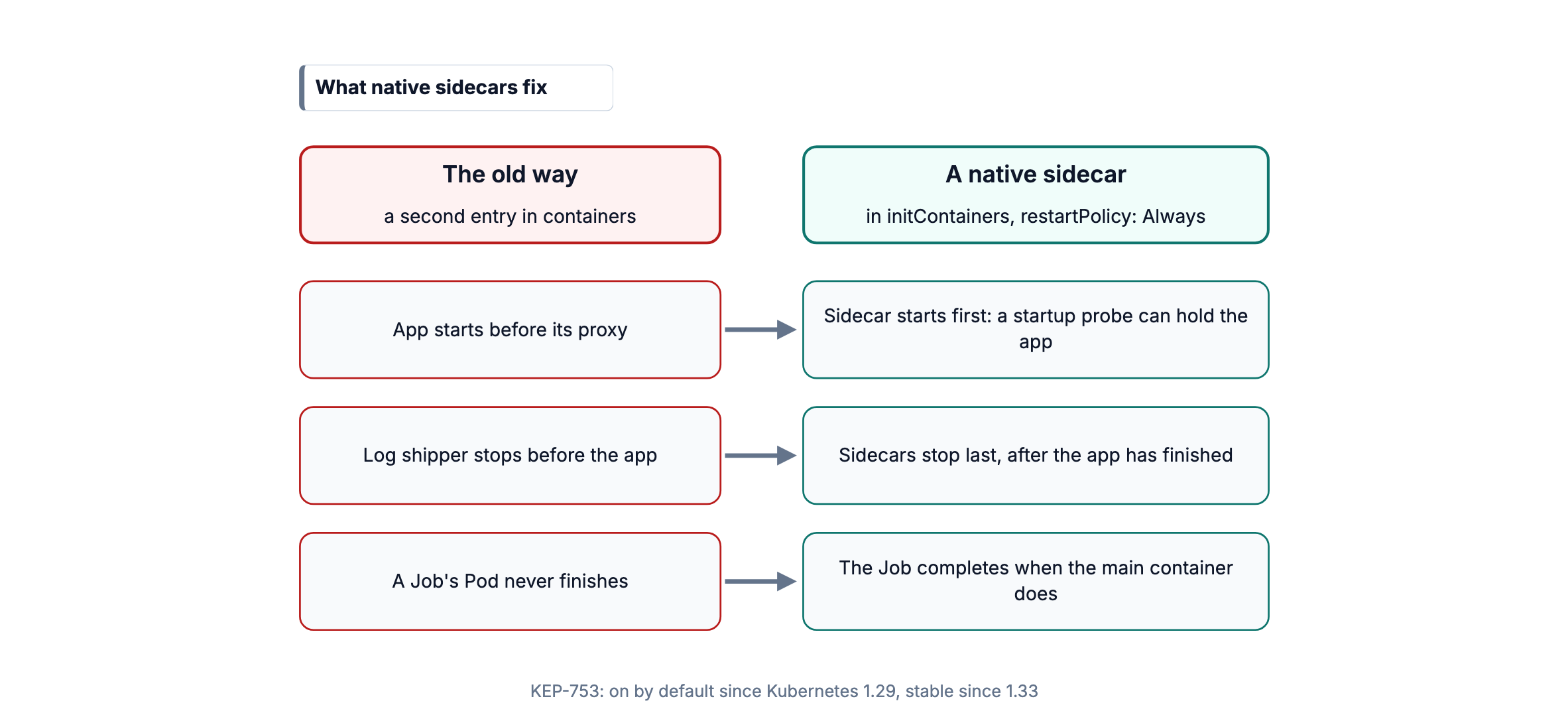
First, the problem. For years, a sidecar was just a second container in the Pod. Kubernetes didn't know it was special. So at start-up, the app could start before its proxy was ready, and its first requests went nowhere. At shutdown, a log shipper could stop before the app did, and the last logs were lost. And in a Job, the sidecar kept running after the work was done, so the Job never finished. Native sidecars fix the order and the Jobs, and with a startup probe, the proxy is ready first too. First proposed in 2018, on by default since Kubernetes 1.29, stable since 1.33.
Declaring one
Here's one. A Job that writes a nightly report, with a log-shipping sidecar. The sidecar goes in the init containers list. Not containers. This one line makes it a native sidecar. Restart policy Always, on the container. And a startup probe. Remember that one. It matters in a minute. The report itself goes in containers, as usual.
A native sidecar's life
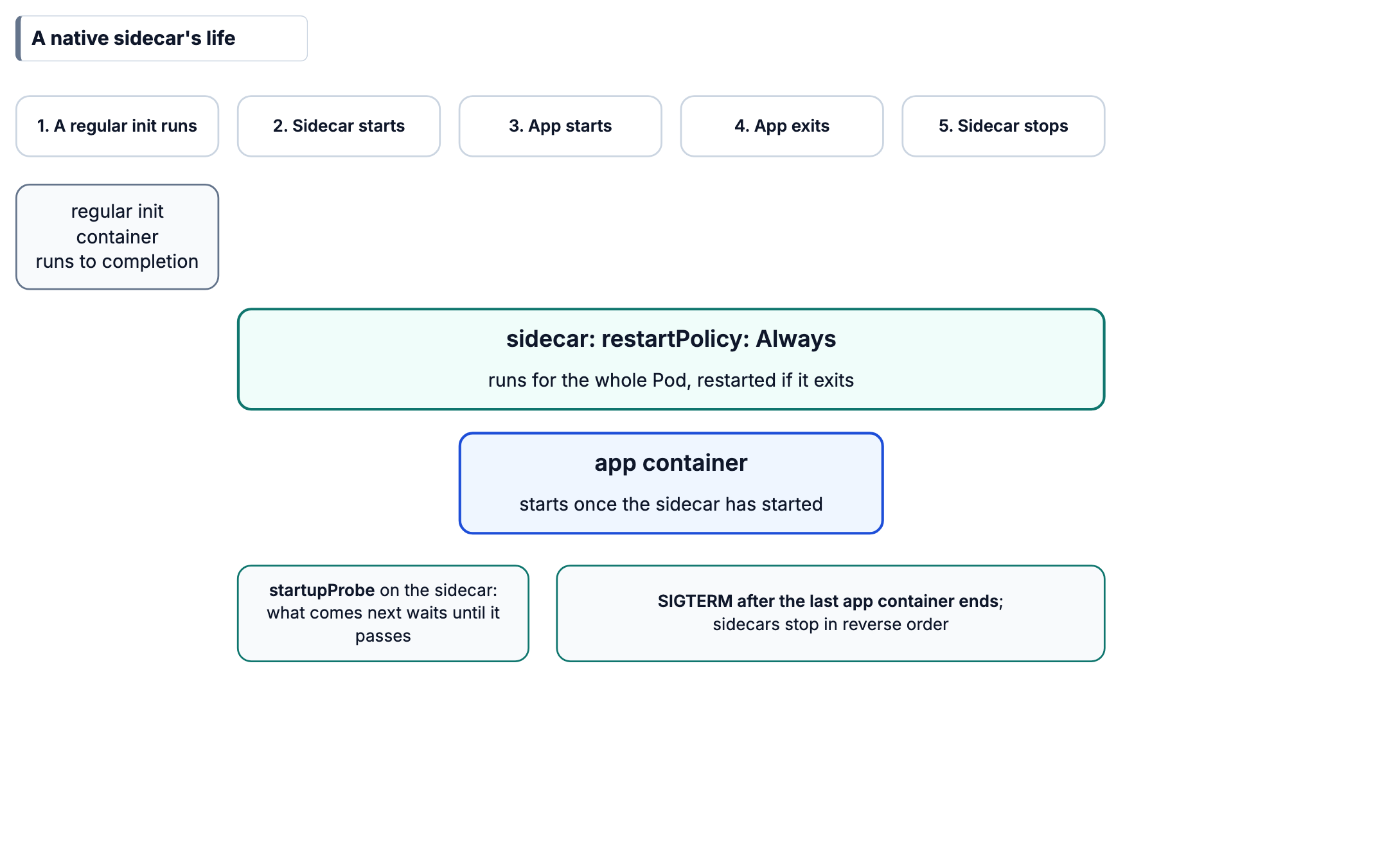
Now its life in the Pod. Everything in the init containers list starts in the order you write it. Here, a regular init container comes first, and runs to completion. Then the sidecar. It starts at its place in the list, but it doesn't have to finish. It runs for the whole Pod, and it's restarted if it exits. Here's the surprise. Starts first is nearly in parallel. A readiness probe on the sidecar does not make the app wait. Only a startup probe does, or a blocking post start hook. Once that probe passes, the kubelet moves on. To the next init container, or, as here, to the app. And at the end, the order reverses. The sidecars get their stop signal only after the last app container has finished, and they stop in reverse order.
Jobs, exit codes and probes
A few more things worth knowing. In a Job, the sidecar no longer holds things up. The Job completes when the main container finishes. At shutdown, a sidecar may be cut off, so a non-zero exit code from it is normal. Tools should ignore it. Sidecars support startup, readiness and liveness probes. And a sidecar's readiness counts towards the Pod's.
What kubectl shows
In kubectl get pods, the ready column counts native sidecars too. While the Pod starts, the status shows init, a number out of a number, and that count includes your sidecars. A sidecar that has started counts as done.
Istio uses them too
If you run Istio in sidecar mode, its proxy is a native sidecar now, on by default since Istio 1.27. With one catch. Istio only does it when the kubelet is 1.33 or later. For a scheduled Pod, that's the kubelet on its node. For a Pod that isn't scheduled yet, it checks every node in the cluster, so one old node switches it off.
Remember
Let's recap. A native sidecar is an init container with restart policy Always. Only a startup probe, or a blocking post start hook, makes the app wait for it. It stops last, after the app, in reverse order. And Jobs complete, and a sidecar's exit code at shutdown is ignored.
Practice and what's next
That's native sidecars. If you're studying for the CKAD, the Certified Kubernetes Application Developer exam, multi-container Pods are on the exam, so try one in a lab. See you next time. That's the series. There's more on the channel. Alpaca Mango. Go on, then. Mate.
Hands-on labs
Now try it on a real cluster
A real Kubernetes cluster in your browser for every lab, checked as you go.
See the labs
Gazeek Flash · free
Exam questions on your phone
Free questions on Application Design and Build: quick-fire batches and timed exams, on the web or Android.