Service mesh sidecars vs ambient mode
A service mesh puts a proxy on every call; Istio's sidecar mode puts an Envoy in every Pod, and ambient mode moves it to a ztunnel per node plus optional waypoints. North-south and east-west, mutual TLS, native sidecars since Istio 1.27, and how to choose.





Now try it on a real cluster
The videos are free. Gazeek's hands-on labs give you a real Kubernetes cluster in your browser for every lab, with checks that tell you when you've got it right: the practice the CKA and CKAD exams need.
The diagrams, full size
Copy any of them into archhy, free, and change it for your own system.
After this lesson you can
- Explain north-south and east-west traffic and what a mesh adds
- Compare where the proxy runs in sidecar mode and ambient mode
- Describe mutual TLS between services in ambient mode with no restarts
- Choose sidecar or ambient mode for a cluster
Transcript
Service mesh sidecars vs ambient mode
Space Llama here, for the last episode of the series, and the biggest user of sidecars of all: the service mesh. Today, Istio's sidecar mode versus ambient mode, and what sidecarless really means.
What a mesh adds
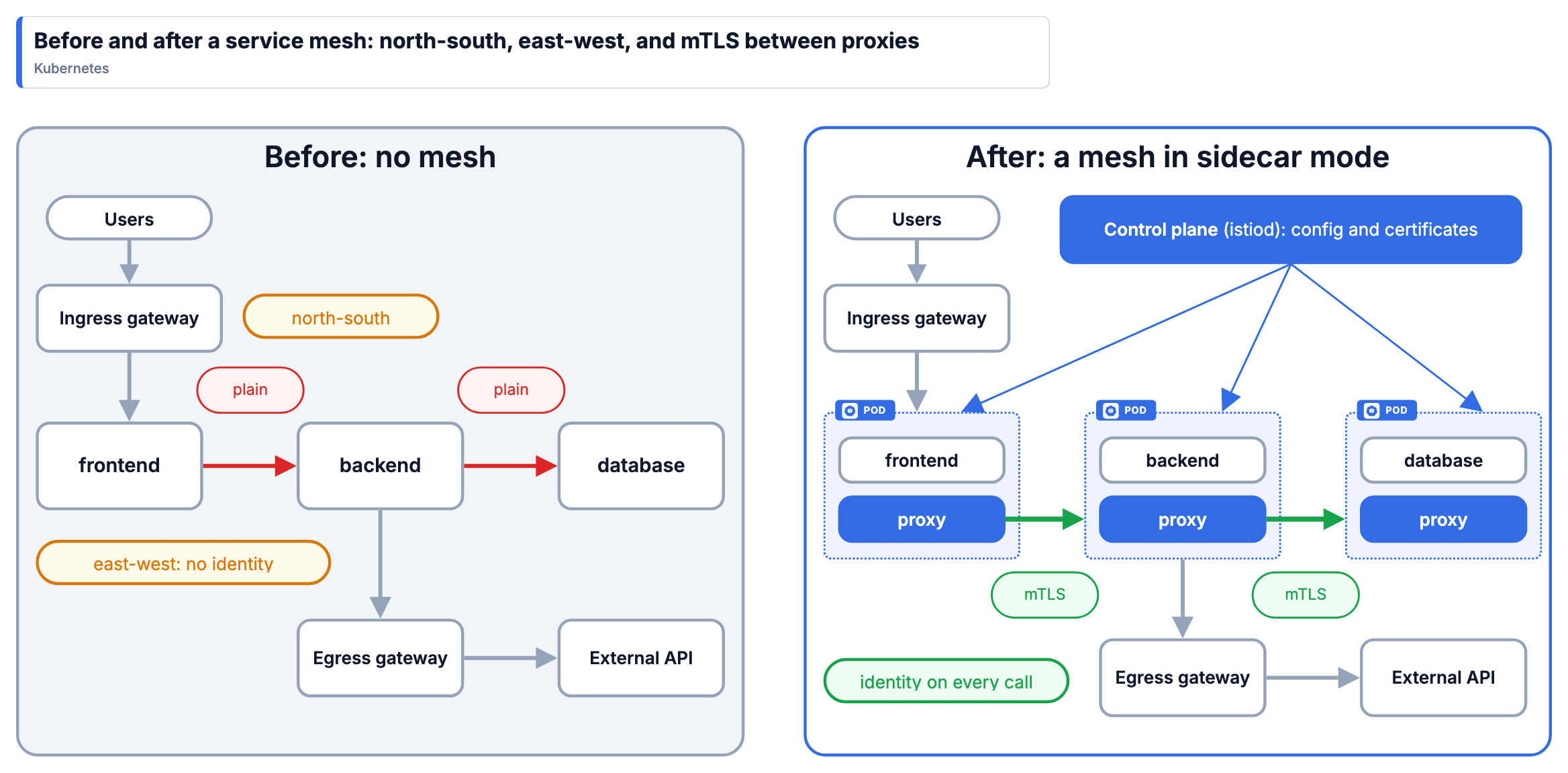
Picture a shop. Users come in through an ingress gateway to a frontend, which calls a backend, which calls a database. Traffic crossing the cluster's edge is north-south. Traffic between services inside the cluster is east-west. Without a mesh, east-west calls are plain text, and the backend can't know a call really came from the frontend. A mesh puts a proxy on every call. Istio's control plane, istiod, configures the proxies and issues their certificates. So the proxies use mutual TLS, Transport Layer Security, and every call carries an identity, with no change to the app's code.
Where the proxy runs
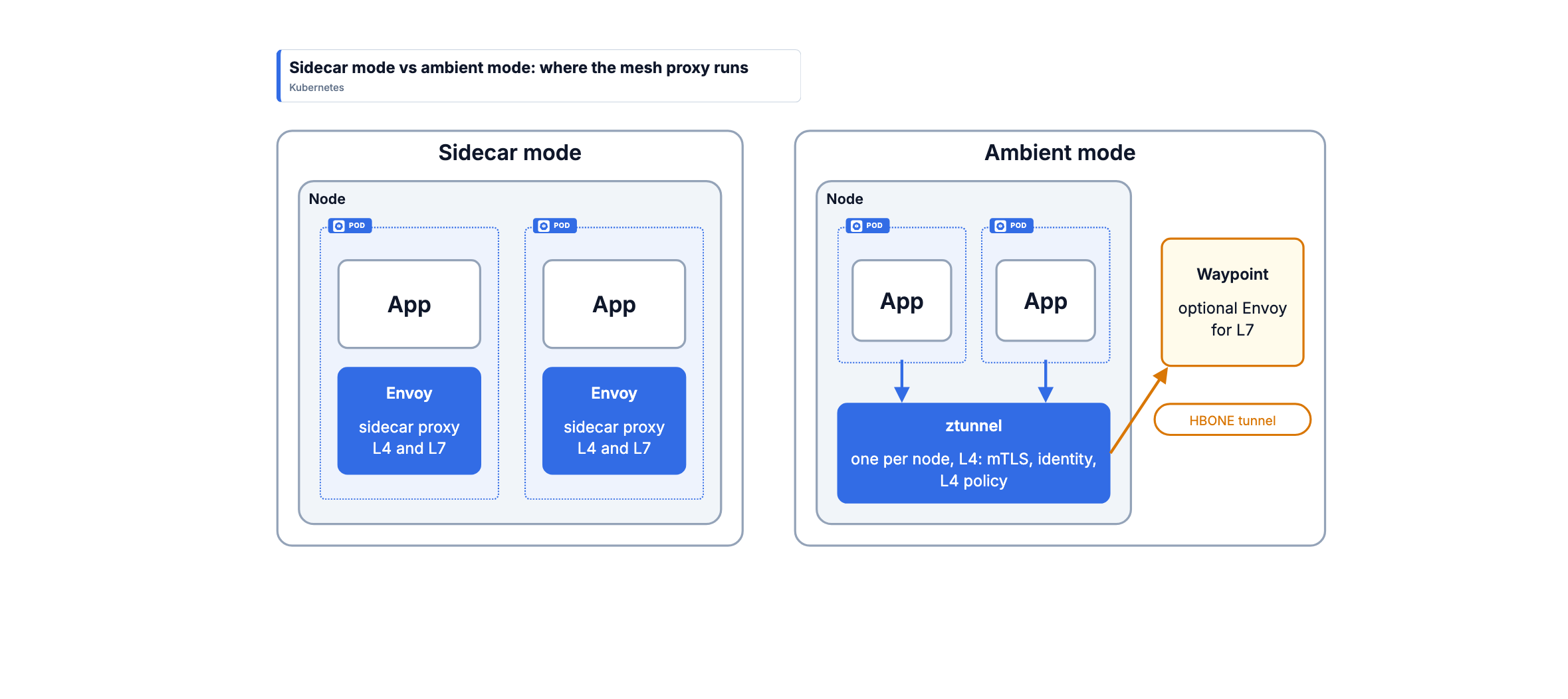
Here's where the proxy runs in each mode. Sidecar mode on the left, ambient mode on the right. Sidecar mode: Istio injects an Envoy proxy beside each app, in every Pod. It handles layer four and layer seven. Ambient mode takes the proxy out of the Pod. One ztunnel per node handles layer four only: mutual TLS, identity, policy and telemetry. For layer seven, like HTTP routing, you add a waypoint: an Envoy Deployment outside your Pods, only where you need it. And joining needs no restart. Label the namespace, and the Pods stay just as they are. So sidecarless doesn't retire the pattern. The proxy moves, from the Pod to the node, and to a shared Deployment.
Sidecar mode today
In sidecar mode, a webhook injects the proxy when a Pod is created. So existing Pods must restart to join. The proxy's old problems: the app could start before it, it could stop before the app, and Jobs never finished. Native sidecars fixed those. Istio 1.27 turned native sidecars on by default. The catch: a single node with a kubelet older than 1.33 can switch them off.
Mutual TLS for every service
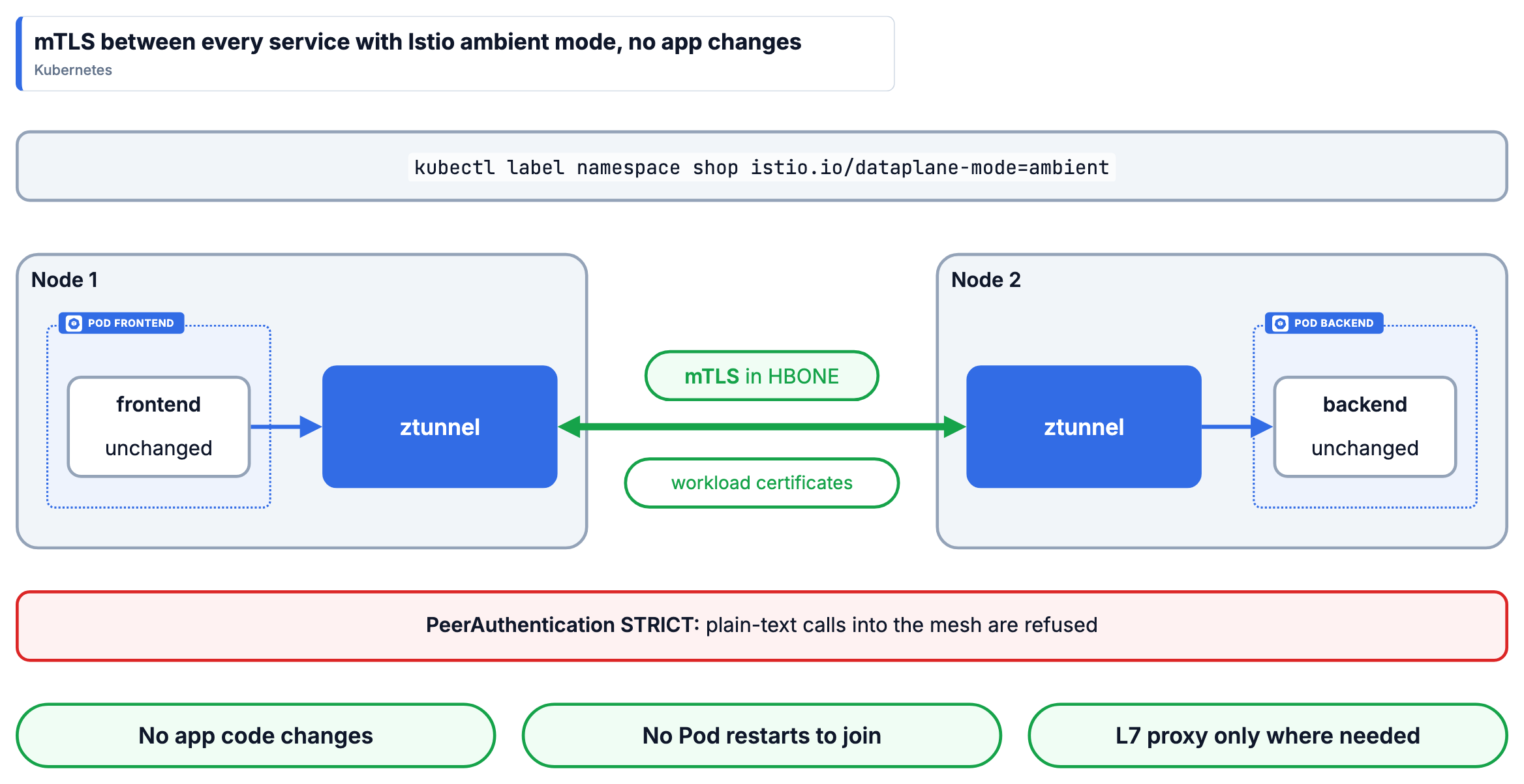
Here's the everyday case: mutual TLS between every service, with no app changes. Label the namespace for ambient mode. The frontend and backend stay unchanged. The ztunnels on their nodes carry the traffic in mutual TLS, with workload certificates. Then one small policy refuses plain-text calls into the namespace. No Pod restarts to join, and a layer seven proxy only where you need one.
The policy, line by line
Here's that policy in YAML. Eight lines, and that's all of it. The kind is PeerAuthentication. It comes from Istio's security API, not from Kubernetes itself. The metadata puts it in the shop namespace, so it covers the services there. And the spec sets the mutual TLS mode to strict. Plain text is refused, and in ambient mode the ztunnel enforces it.
Sidecar or ambient
Side by side. Sidecar mode gives each workload its own keys, Istio's strongest option, and it supports virtual machines and EnvoyFilter. Ambient mode uses fewer resources, has lower latency in Istio's own comparison, and joins without restarts. It's stable for a single cluster. And you don't have to pick just one. Sidecar and ambient Pods can live in the same mesh.
For the CKAD
For the CKAD, the Certified Kubernetes Application Developer exam, Istio isn't on the curriculum. Native sidecars and multi-container Pods are. Know how an injected sidecar shows up: ready two of two, an extra container in describe, and dash c on kubectl logs.
Remember
Let's recap. A mesh puts a proxy on every call, and a control plane hands out the certificates for mutual TLS. Sidecar mode puts an Envoy in every Pod. Ambient mode uses a ztunnel per node, and waypoints only for layer seven. Either way, the sidecar pattern lives on. The proxy just moved house.
Practice and what's next
That's the series: init containers, sidecars, ambassadors, adapters, and the mesh. All six articles are on the Gazeek blog, with the YAML. Read more about this one from the link below. For exam-style practice, try the practice questions. Thanks for riding along with me. See you next time.
Hands-on labs
Now try it on a real cluster
A real Kubernetes cluster in your browser for every lab, checked as you go.
See the labs
Gazeek Flash · free
Exam questions on your phone
Free questions on Application Design and Build: quick-fire batches and timed exams, on the web or Android.