The tool family
Where Terraform and Packer sit beside configuration tools, how Terraform, HCP Terraform, Terraform Enterprise and OpenTofu relate, and the license story from 2023 to 2025.





Diagrams in this video · 2Free in archhy
The diagrams, full size
Copy any of them into archhy, free, and change it for your own system.
After this lesson you can
- Place Packer, Terraform, configuration tools and applications in their layers
- Tell Terraform, HCP Terraform and Terraform Enterprise apart
- Explain what OpenTofu is and why it exists
- Summarize the 2023 license change and what followed
Transcript
The tool family
G'day. Space Llama here. We've got the ideas. Now let's meet the tools, and sort out a few names that keep changing. Terraform, Packer, HCP Terraform on the HashiCorp Cloud Platform, and OpenTofu. Let's put each one in its place.
Where each tool sits
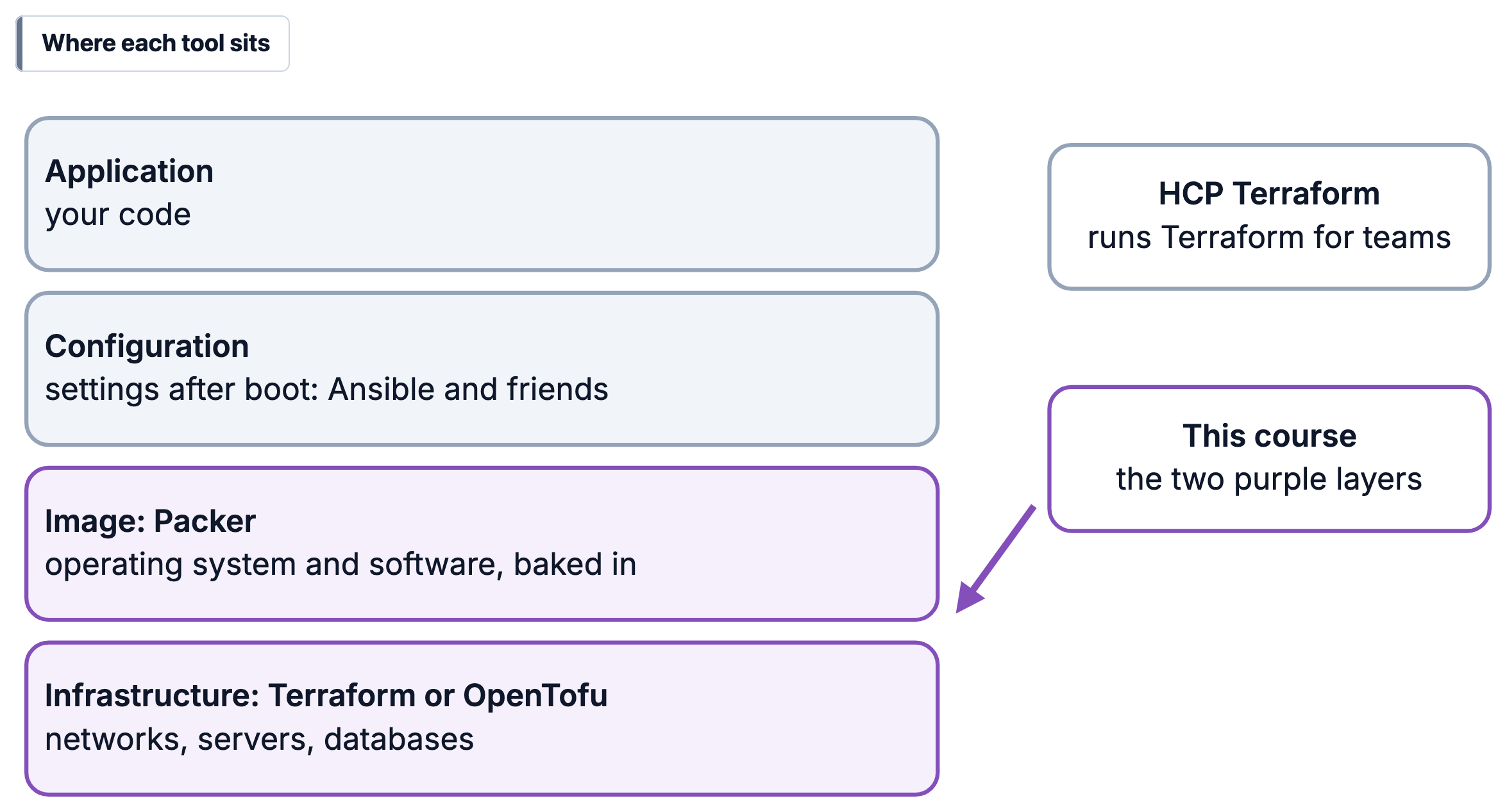
Think of it in layers. At the bottom is infrastructure. Networks, servers, databases. Terraform builds and changes those. Next is the image. The operating system and software, baked in ahead of time. Packer builds those. Packer makes identical images for many platforms, from one template. Above that, configuration tools such as Ansible can set things up after a machine boots. With good images, there's less to do at boot, which is faster and more predictable. And on top, your application. This course covers the two purple layers.
Terraform and its relatives
Terraform itself is a command-line tool you run yourself. HCP Terraform is HashiCorp's hosted service that runs Terraform for teams. You may know its old name, Terraform Cloud. It was renamed in April 2024. Terraform Enterprise is the self-hosted version of HCP Terraform, for companies that run it on their own servers. And OpenTofu is a community fork of Terraform. Almost everything you learn here applies to it too.
The HCP side of the family
HCP stands for HashiCorp Cloud Platform. Two of its services matter here. HCP Terraform runs Terraform for a team. It keeps the state, runs the plans, and adds permissions and guardrails. HCP Packer is a registry. It records the images your Packer builds produced, and where. The images themselves stay in your cloud. HCP Terraform has a free tier to start with. Where a feature needs a paid edition, I'll say so.
The license story
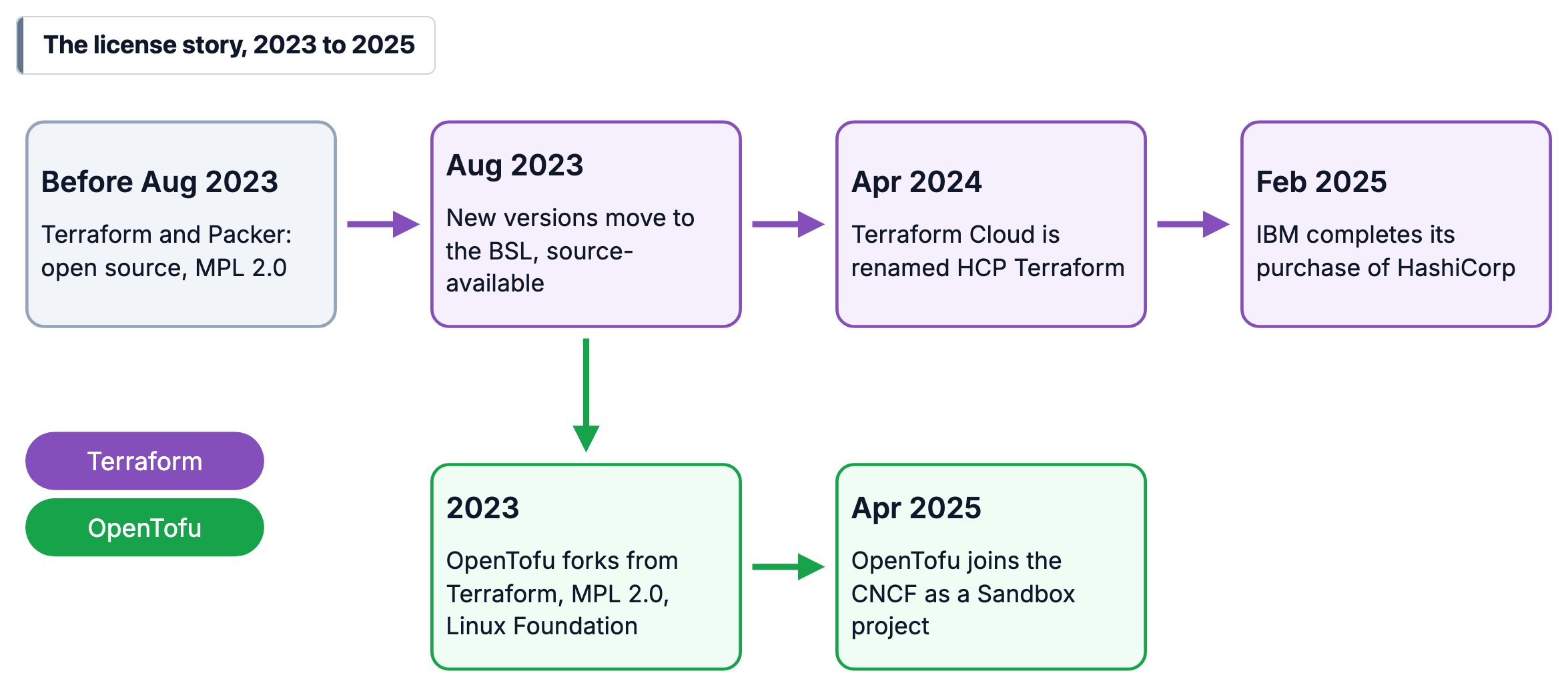
So why is there a fork? Here's the license story, in under a minute. Terraform and Packer were open source, under the Mozilla Public License, MPL 2.0. In August 2023, HashiCorp moved new versions to the Business Source License, the BSL. The source is public, but it isn't an open source license. You can still use it in production. The limit is on offering it to others in competition with HashiCorp's paid products. In response, a group of companies forked the last open source version. That fork is OpenTofu, at the Linux Foundation. In February 2025, IBM completed its purchase of HashiCorp. And in April 2025, OpenTofu joined the Cloud Native Computing Foundation as a Sandbox project.
Which one should you learn?
Which one should you learn? Honestly, either. State, plans and providers work the same way in both. This course uses Terraform, because half of it is about HCP Terraform and HCP Packer, which are HashiCorp products. Where OpenTofu differs in a way that matters, I'll say so. And if your company already picked one, learn that one. The skills move across easily, a bit like switching between two brands of spacesuit.
Recap
Let's recap. Terraform builds infrastructure, and Packer builds the images it launches. HCP Terraform runs Terraform for teams, and Terraform Enterprise is its self-hosted version. OpenTofu is the open source fork, born from the 2023 license change.
Practice and what's next
That's the family, and the family history. Next lesson starts part two, Providers, resources and the graph. Time to look inside Terraform. See you there. More videos on the channel. Alpaca Mango. I'll be there. I'm always there. Mate.

Gazeek Flash · free
Exam questions on your phone
Free questions on Why infrastructure as code: quick-fire batches and timed exams, on the web or Android.