LangChain vs LangGraph: which do you need?
LangChain and LangGraph aren't rivals: LangChain gives you the parts, LangGraph decides the order they run in. How they fit together today, four questions that decide which layer you work in, and the comparison people usually mean instead.





The diagrams, full size
Copy any of them into archhy, free, and change it for your own system.
After this lesson you can
- Explain why LangChain versus LangGraph is usually the wrong question
- Say which layer you work in for a given agent
- Use four questions to choose
- Name the comparison people often mean instead
Transcript
LangChain vs LangGraph: which do you need?
Space Llama here. LangChain or LangGraph? It's one of the most searched questions about agent frameworks. And the honest answer is that picking between them is usually a category error. Let me show you why.
The parts, and the order
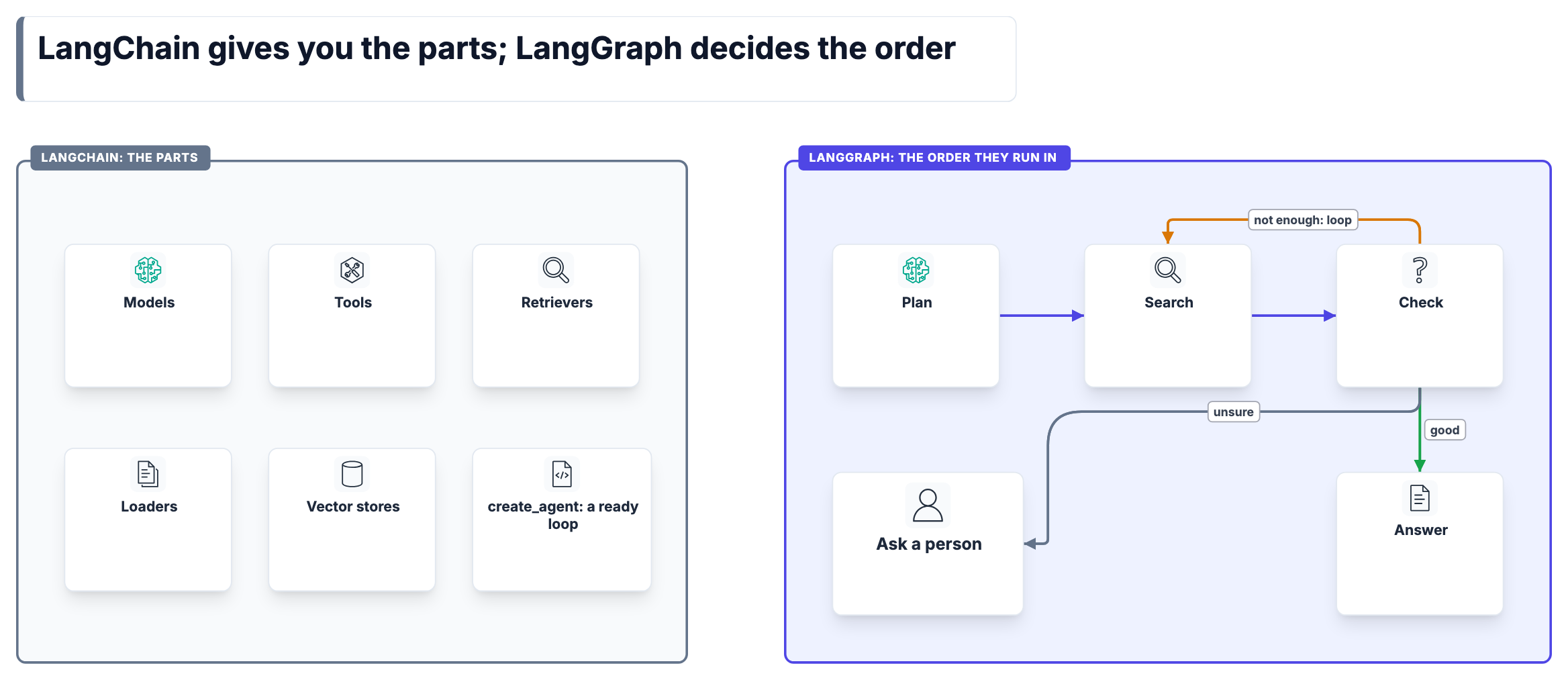
LangChain is a library of integrations and abstractions. Models, tools, retrievers and loaders, behind one interface, plus a ready-made agent loop. LangGraph is a way to express an agent's control flow as an explicit graph: state, nodes and edges. In short, LangChain gives you the parts. LangGraph decides the order they run in, and lets you see it. They come from the same people, and they're often used together.
They're layers, not rivals
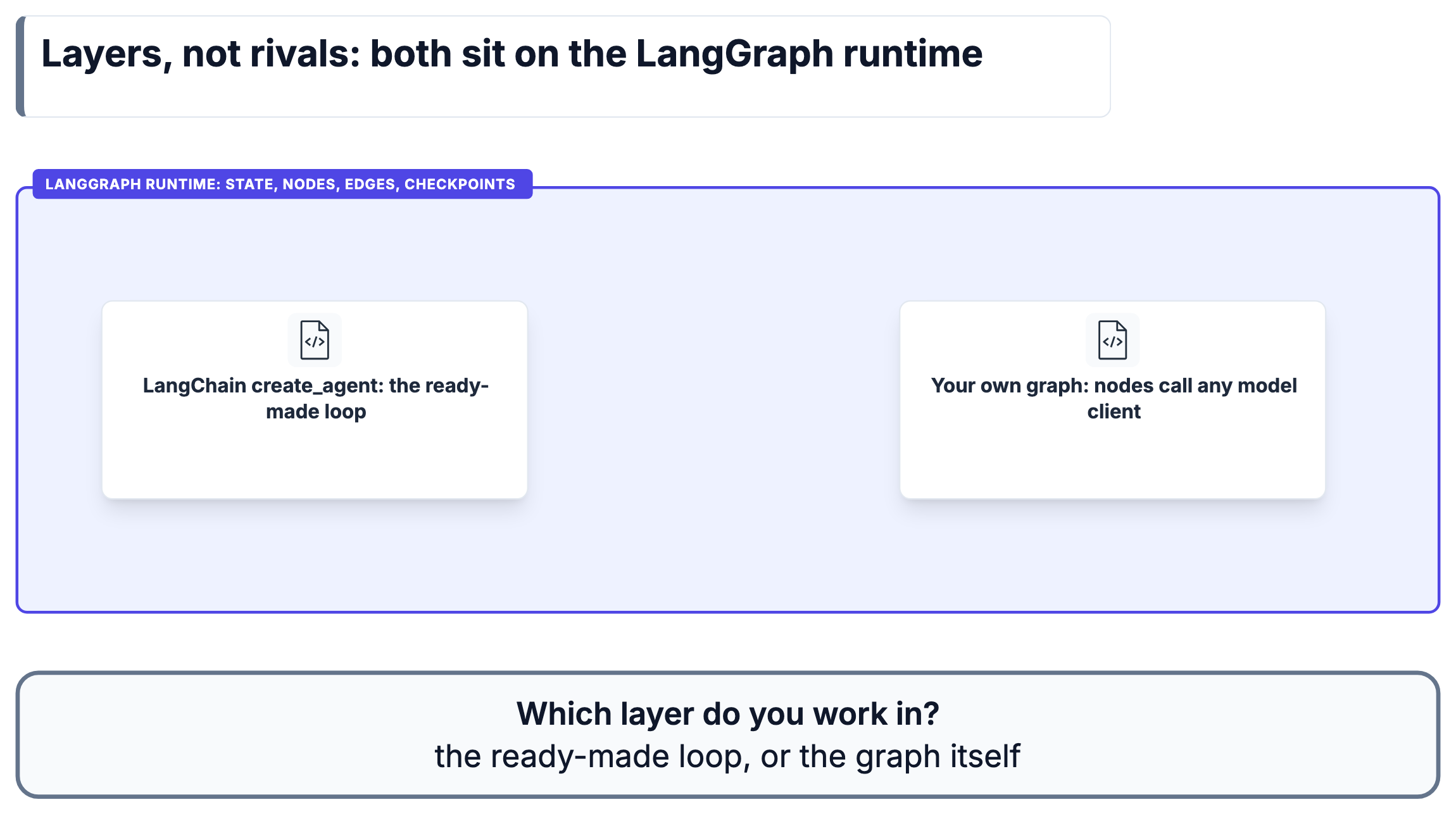
Today, LangChain's agents are built on top of LangGraph. Use create agent, and LangGraph is already running underneath. And LangGraph works on its own. Its nodes can call any model client you like. So the real question isn't which one. It's which layer you need to work in: the ready-made loop, or the graph itself.
Four questions
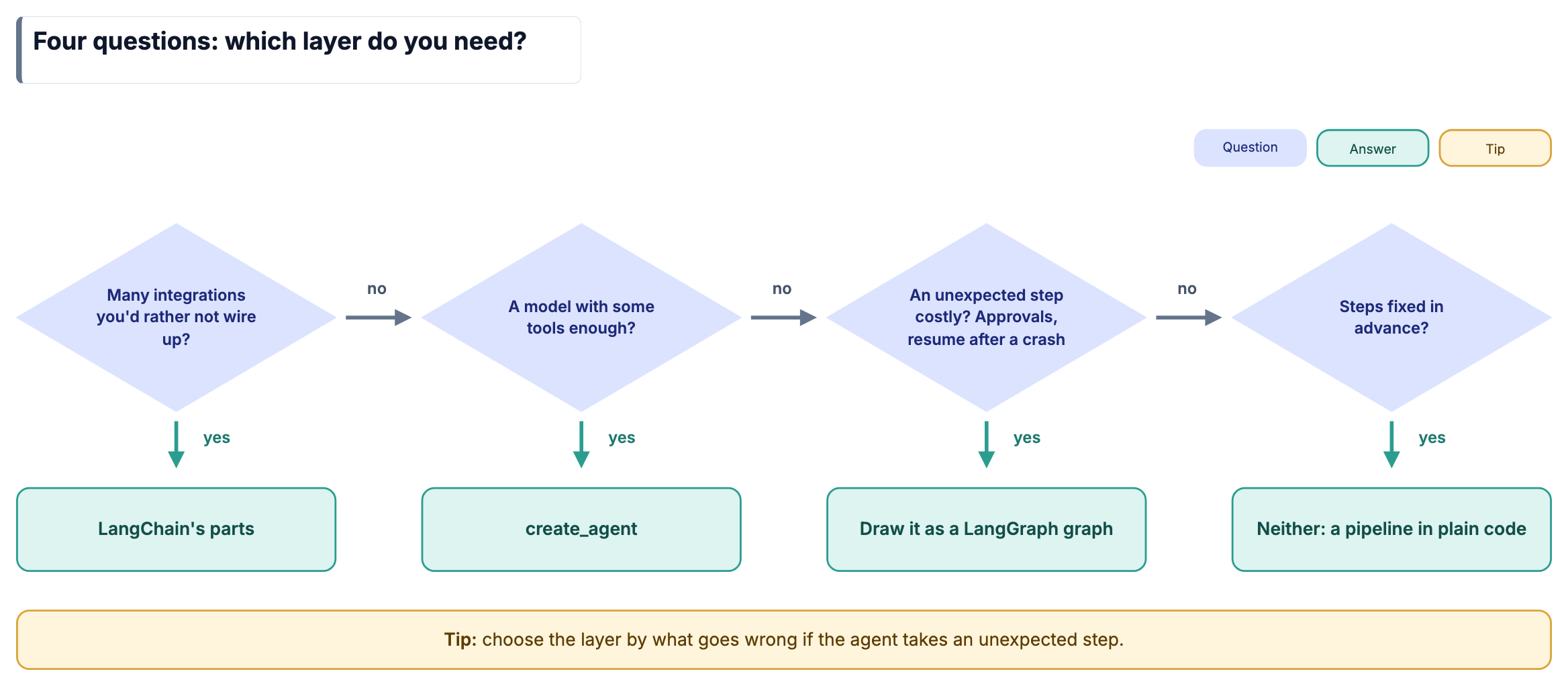
Four questions decide it. Do you need lots of integrations, models and data sources you'd rather not wire up yourself? Use LangChain's parts. Is a standard agent loop enough, a model with some tools? Then create agent is the quick path. Is an unexpected step expensive? Do you need approvals, or runs that resume after a crash? Then write the permitted steps down as a LangGraph graph. And if the steps are fixed in advance, you need neither. That's a pipeline, and plain code does it well.
The comparison people usually mean
Here's a twist. Nine times in ten, LangChain versus LangGraph really means something else. It means explicit graphs, versus a team of role-playing agents that work out the coordination between themselves. That's a trade of control against expressiveness, and it's the next lesson: CrewAI and Microsoft's agent frameworks.
Remember
Let's recap. LangChain gives you the parts, and LangGraph the order they run in. They're layers, not rivals. Choose the layer by what goes wrong if the agent takes an unexpected step. And if the steps are fixed, use neither.
The full article, and what's next
The full article, LangChain versus LangGraph, is free on Alpaca Mango. The link is below. Next lesson: CrewAI versus AutoGen, and what Microsoft offers now. See you there.
Read the article
LangChain vs LangGraph: what's the difference?: the whole idea in writing, free.
Read it ↗